


VIDEO NO LONGER AVAILABLE
Tamerlano or The Death of Bajazet (RV 703)
Music by Antonio Vivaldi
Tragedy in music in three acts
Libretto Agostino Piovena
First performance Verona, Teatro Filarmonico 1735
(Critical Edition by Bernardo Ticci, 2019 – Variations by Ottavio Dantone)
Bajazet Gianluca Margheri
Tamerlano Filippo Mineccia
Asteria Delphine Galou
Irene Marie Lys
Andronico Federico Fiorio
Idaspe Giuseppina Bridelli
Dancing roles: Davide Angelozzi, Kyda Pozza, Elda Bartolacci, Alessandra Ruggeri, Graziana Marzia, Sara Ariotti
Harpsichord Director Ottavio Dantone
Direction, sets, and costumes Stefano Monti
Lighting design Eva Bruno
Video/3D content Cristina Ducci
Choreography Marisa Ragazzo, Omid Ighani
Canvas painting Rinaldo Rinaldi, Maria Grazia Cervetti
Illustrations Lamberto Azzariti
Sculptures Vincenzo Balena
Set construction Laboratorio Scenografia Pesaro
Costume creation Sartoria Klemann
ACCADEMIA BIZANTINA
DACRU DANCE COMPANY
NEW PRODUCTION
Teatro Alighieri di Ravenna
in co-production with Teatro Municipale di Piacenza, Fondazione I Teatri di Reggio Emilia, Teatro Comunale Pavarotti-Freni di Modena, Teatro del Giglio di Lucca
“For some years now, a thesis has been gaining ground among critics and musicologists that baroque opera could become the musical theater of the future,” notes director Stefano Monti, who also handles sets and costumes, “due also to the fact that the dramatic theater of the seventeenth and eighteenth centuries has a timeless emotional power. (…) Although constructed around characters with historiographical relevance, the opera in question is characterized by its ahistoricity. Everything centers on passions, to the point of madness, the sublime mixes with the terrible, beauty with brutality… they are nothing but the continuous oscillation between the highs and lows of life.” The pretext is indeed as historical as the Ottoman Empire’s Sultan Bayezid I and the Mongol leader Timur who captured him at the Battle of Ankara in 1402; but Tamerlano, or the Death of Bajazet – a “pasticcio” on a libretto by Agostino Piovena in which, as was customary at the time, pages by Vivaldi and materials borrowed from other composers and other titles converged – is a triumph of inaction dominated by passions. A monolith of almost Kubrickian memory will stand on the stage to pursue the poetics of baroque “wonder” but also the sense of a space out of time.
“Being a ‘pasticcio’, this score is obviously characterized by a marked stylistic variety, but Vivaldi’s writing is easily recognizable compared to the style of the authors involved, namely Broschi, Hasse, and Giacomelli,” explains Ottavio Dantone, at the helm of Accademia Bizantina, celebrating 40 years of rediscovering the ancient and baroque repertoire and prestigious achievements worldwide. “The Vivaldi opera composer is still often underestimated today: certainly, in his production, there emerges a compositional urgency and a certain ‘entrepreneurial’ character, but his writing skill, made of seductive melodic, harmonic, and rhythmic solutions, remains evident… it gives us an extremely connotative vision of the theatrical taste of the time. Philology is not just about the correctness of embellishments, articulations, or the use of ancient instruments. It is above all the knowledge of the customs and needs not only expressive but often also practical of baroque theater.”
In this new production, the baroque dimension of the title also emerges from the re-proposal of the encounter between puppet theater and melodrama – an encounter that already took place in seventeenth-century Venice, where the San Moisè was the first opera house also for puppets; over time, musicians such as Vivaldi himself composed for puppet theater. The inclusion of dance also has a philological reason, in the “dances” mentioned in the original libretto (although there is no evidence of a musical counterpart). In this case, the work of the DaCru Dance Company focused on the need to make singer and dancer a single entity, with the former representing the physical body and the latter the subtle body, the space of resonances… through an unconventional language, thanks to the Urban Fusion training of the performers: Kyda Pozza, Davide Angelozzi, Elda Bartolacci, Graziana Marzia, Sara Ariotti, and Alessandra Ruggeri.
The opera in three acts – on this occasion presented in the critical edition by musicologist Bernardo Ticci, with variations made by Dantone himself – contemplates the greatness and decline of an Empire with which the Serenissima had to contend for much of its history. The historical context is, however, less relevant than the opposition between the vanquished and the victor, prisoner and jailer. Bajazet, entrusted to Bruno Taddia for the premiere on Saturday, January 14, and to Gianluca Margheri for the repeat on Sunday, January 15, chooses death rather than remain in the power of his enemy, Tamerlano, played by Filippo Mineccia. To emphasize and complicate the drama, there are two women: Bajazet’s daughter, Asteria (Delphine Galou), whom Tamerlano desires as his wife despite her already loving Andronico (Federico Fiorio), and Irene (Marie Lys), whom Tamerlano intends to abandon in favor of Asteria. Amid real and presumed betrayals, the (unheeded) advice of Idaspe (Andronico’s confidant played by Giuseppina Bridelli), disguises, metaphorical and non-metaphorical poisons… the story spirals towards the inevitable conclusion: Bajazet’s suicide, whose death appeases Tamerlano’s wrath, returns Asteria to Andronico and Irene to her promised spouse. “A conventional happy ending that, due to its intrinsic contradiction, leaves an open epilogue to many reflections,” notes Stefano Monti again. “This determined the choice of an ending to the staging in which the end of a story and a break between performers and spectators were not produced, but placed both before new questions.”
EXTRA
LIVE FROM.
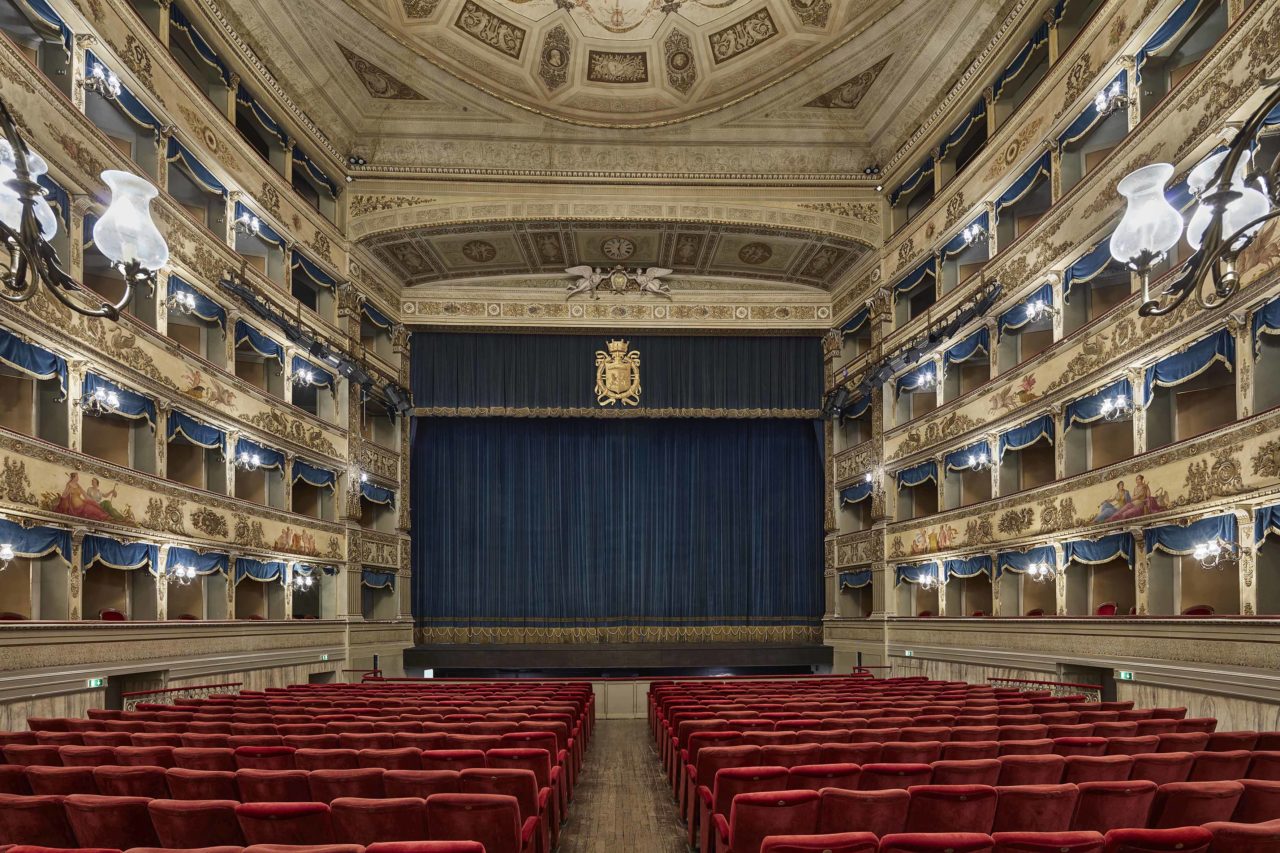
ALIGHIERI THEATRE RAVENNA
Early decades of the 19th century: after over a hundred years, the Communicative Theatre, entirely made of wood, is deteriorating, and the Civic Administration decides to build a new structure. Meanwhile, a suitable location must be found, and the choice falls on Piazzetta degli Svizzeri, shabby and surrounded by shanties, but right in the city center. In 1838, the project is entrusted to two Venetian architects, the Meduna brothers, Tomaso and Giovan Batista. The former oversaw the restoration of the Teatro La Fenice in Venice, which was partially destroyed by a fire. He also designed the first railway bridge connecting Venice to the mainland. Thus, a neoclassical building is born, similar in many respects to the Venetian theatre. It is the apostolic delegate, Monsignor Stefano Rossi, who suggests dedicating it to Dante Alighieri.


