


AVAILABLE UNTIL AUGUST 14, 2026
LE CARNAVAL, MASCARADE ROYALE
Music by John Baptist Lulli
Opéra-ballet
Libretto by Philippe Quinault
critical edition edited by Bernardo Ticci – BTE2025
from an idea by Marcello Corvino
Première Dessus Valeria La Grotta
Deuxième Dessus Giuseppina Bridelli
Haute-Contre Philippe Talbot
Taille Cyril Auvity
Premier Basse Biagio Pizzuti
Deuxième Basse Alexandre Baldo
Dancers
Mariana Porceddu, Giada Inserra, Leila Ghiabbi, Francesco Saverio Cifaldi, Mario Consolazio, Marianna Caratelli, Ginevra Cicatello, Maurizio Paolantonio
Direction and scenes Emiliano Pellisari
Choreography Emiliano Pellisari and Mariana Porceddu
Costumes Daniela Piazza
Concept art Nora Bujdoso
Lighting design Emiliano Pellisari and Gregory Zencher
Modo Antiquo Orchestra
Conductor Federico Maria Sardelli
Choir The Grand Prince’s Musicians
Choir conductor and assistant director Samuel Lastrucci
Stage director Claudia Spogli
Assistant stage director Maristella Ragnedda
Lighting assistant Mattia Mazzini
Collaborative pianists Enrico Bissolo and Nicola Lamon
Theatrical tailoring Lucia Fortuna
Tailors Isabella Franzoni, Sonia Gallerani
Wigs and accessories Simonetta Taibi and Zein Batayneh
Makeup Luca Oblach and Lucia Mariotti
WORLD PREMIERE
NEW PRODUCTION
Production Fondazione Teatro Comunale di Ferrara
Coproduction Fondazione Teatro Comunale di Modena
In collaboration with Orchestra Modo Antiquo and NoGravity Theatre
After 350 years, Le Carnaval, Mascarade Royale returns to shine in its World Premiere at Ferrara’s Municipal Theater. More than three and a half centuries after its triumph at the court of Louis XIV, the epic opera-ballet *Le Carnaval, Mascarade Royale* is being revived in a magnificent new production by the Teatro Comunale di Ferrara, co-produced with the Teatro Comunale di Modena. A masterpiece by Giovanni Battista Lulli and a symbol of the Sun King’s court, the production—based on an idea by Marcello Corvino—combines the score, performed by Federico Maria Sardelli and the Modo Antiquo orchestra, with the dancers of NoGravity, directed by Emiliano Pellisari, who blend music and movement in a contemporary stage production inspired by Baroque theater. The result is a performance in which Carnival becomes a space of freedom, metamorphosis, and creativity.
Court ballet experienced a season of extraordinary vitality in the France of Louis XIV, who in Jean-Baptiste Lully found the perfect ally to bring to the pinnacle of perfection what had become an elite form of entertainment and a valuable tool for celebrating absolute power.
Le carnaval premiered at the Louvre in January 1668 and was revived at the Opéra in the fall of 1675, with librettos by Benserade, Molière, and Quinault. In a bizarre anthology of theatrical ideas, characters drawn from pastoral, bourgeois, and Commedia dell’Arte settings take turns on stage, without neglecting the exotic elements and “Turkish motifs” that were so in vogue at the time. Harlequin and Trivellino, Pulcinella and Scaramouche, the bourgeois gentleman, the shepherds of Arcadia, the Ottoman Mufti, Spaniards, Italians, Gypsies, Basques, and Egyptians bring to life the various entrances of the Mascarade royal, in a solemn yet playful tribute to Carnival—a time of renewed social unity that sets no limits on the imagination.
EXTRA
LIVE FROM.
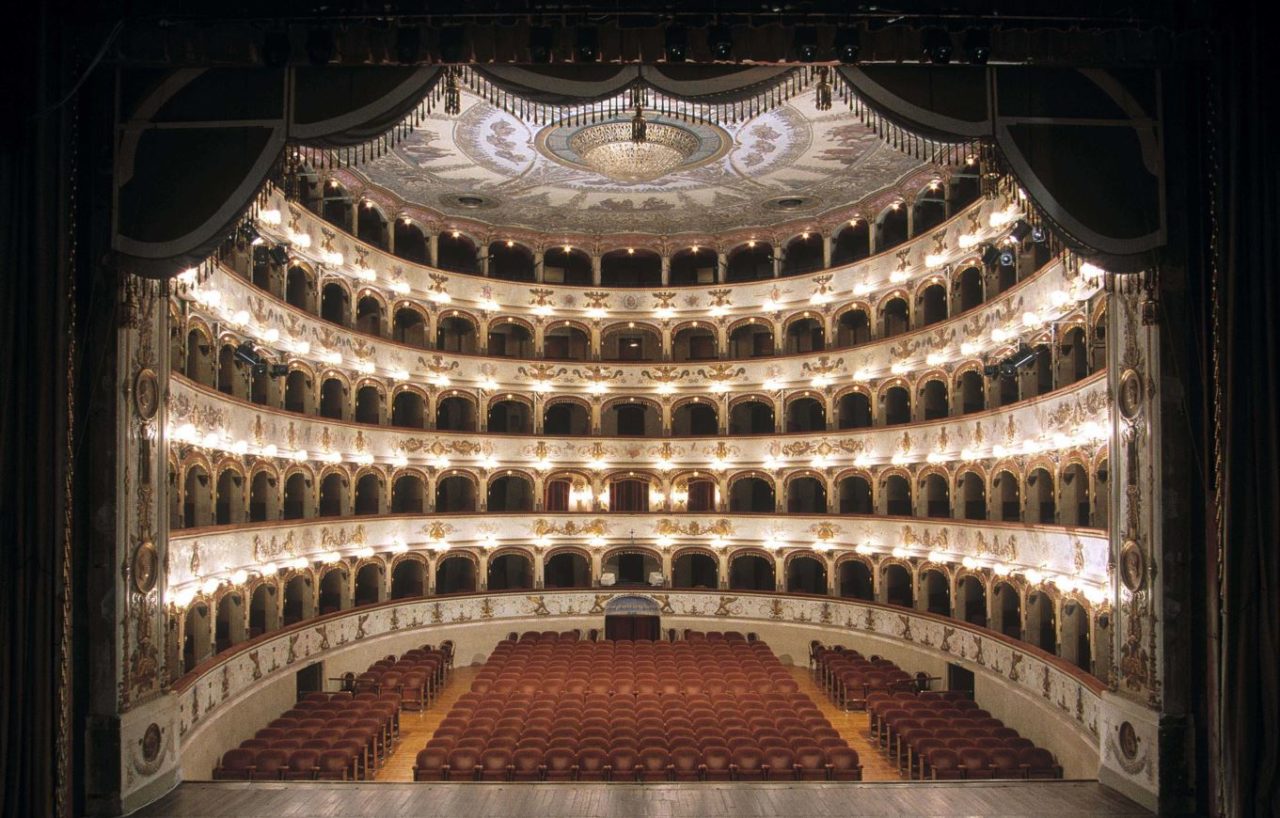
MUNICIPAL THEATER OF FERRARA
Considered one of the most beautiful examples of Italian-style theatre, the Municipal Theatre of Ferrara was built between 1773 and 1797, designed by Antonio Foschini and Cosimo Morelli, and inaugurated in 1798 with the opera Gli Orazi e i Curiazi by Marco Portogallo. It is located on Corso Martiri della Libertà, in the historic center just a few meters from the Estense Castle. On March 21, 2014, the theatre was dedicated to the memory of Claudio Abbado, founder of Ferrara Musica and a key figure in the city of Ferrara for 25 years with memorable operas and concerts.


