

VIDEO NO LONGER AVAILABLE
María de Buenos Aires
Opera Tango – Tribute to Astor Piazzolla on the 100th anniversary of his birth
Music by Astor Piazzolla
Text by Horacio Ferrer
© 1973 – Lagos Publishing House (Warner/Chappel Music Argentina)
María Martina Belli
Payador Ruben Peloni
El Duende Daniel Bonilla-Torres
Dancers MM CONTEMPORARY DANCE COMPANY
Choreographer Michele Merola
Conductor Jacopo Rivani
Direction Carlos Branca
Assistant Director Rosanna Pavarini
Scenography Giulio Scutellari and Carlos Branca
Choreography Assistant Paolo Lauri
Costumes Carla Mellini
Lighting Mattia Mazzini
ORCHESTRA ARCANGELO CORELLI
Bandoneón Davide Vendramin
NATIONAL DANCE FOUNDATION / ATERBALLETTO dance production coordination
NEW PRODUCTION
Co-production of Fondazione Teatro Comunale di Ferrara, Ravenna Festival, Teatro Marrucino di Chieti, Teatro del Giglio di Lucca, and Teatro di Pisa
Ministry of Culture
Region of Emilia Romagna
Municipality of Ferrara
ENI
Under the patronage of the Embassy of the Argentine Republic in Italy
Created together with Uruguayan poet Horacio Ferrer, Maria de Buenos Aires is based on 17 musical numbers, largely inspired by tango. However, Piazzolla’s is a ‘nuevo tango’, based on repetitive, almost obsessive, hypnotic harmonic patterns. The visionary and dreamlike text narrates the human events of a young woman and her descent into the underworld. The bandoneón, a musical instrument initially used in religious processions and later becoming a ‘sacred’ element of tango, becomes the symbol of the Evil that has overwhelmed Maria, a metaphor in turn for the city of Buenos Aires and its endless contradictions. The opera, performed by Amelita Baltar, debuted in 1968 in the Argentine capital, blending sacred, profane, and fantastic. “The opera went unnoticed, quietly, and did not achieve the success it deserved,” comments artistic director Marcello Corvino. “Critics panned it because it betrayed traditional tango. Then he met Milva, who became an interpreter of his most famous songs.” She was the first to perform Maria de Buenos Aires in Italy in 1999 in Palermo. In Ferrara, the piece will be dedicated to the ‘Panther of Goro’, who passed away last April 23.
The show is entrusted to three voices and nine dancers. María will be portrayed by Martina Belli, a versatile mezzo-soprano with a voice of rare charm, accompanied by Argentine-born baritone Ruben Peloni (Payador), while Daniel Bonilla-Torres plays El Duende, the goblin who becomes the passionate narrating voice of the story. In the same role, Bonilla-Torres had previously toured internationally with Milva. The stage is dominated by a scaffold, both a setting and a cage where the story takes shape. Director Carlos Branca, a prominent figure in opera and drama, along with the Arcangelo Corelli Orchestra conducted by Jacopo Rivani and characterized by the distinctive sound of Davide Vendramin’s bandoneón, has involved for this co-production (which unites five Italian theatrical entities) the dancers of MM Contemporary Dance Company of Reggio Emilia, choreographed by Michele Merola with the coordination of the National Dance Foundation / Aterballetto. The artistic cast also includes some professionals from the Fondazione Teatro Comunale di Ferrara, including Giulio Scutellari, who, together with Carlos Branca, signs the sets, and Marco Cazzola the lighting design.
The South American magical realism, ruthless and poetic, is embodied in the story of Maria, simultaneously a child, adolescent, woman, singer, prostitute, and victim of the metropolis of Buenos Aires. Only with death does her shadow regain virginity and is reborn by giving birth to a child bearing her own name. “Even though in Argentine it is called operita, and Piazzolla himself used the term sarcastically, María de Buenos Aires is probably Astor Piazzolla’s most important work,” explains director Carlos Branca. “Drawing from his life, his experiences, his stubborn courage, but also respecting tradition, Piazzolla created an avant-garde work of art.”
The surreal and visionary story is inspired by an urban legend about the unfortunate María, born in a miserable suburb of Buenos Aires. “The protagonist’s events recount the years of poverty, hope, the oppression of a dictatorial state, and the temporary rebirth of this quintessential metropolitan city.” An imaginary city supported and at the same time trapped by a metal structure. “Scenographically, everything is imprisoned, the scaffolding occupying the background of the scene supports walls under construction or crumbling and traps the buildings, its inhabitants, and the music itself,” emphasizes Branca. The operita, for the director, is a kaleidoscope of metaphors, among which the violence stands out. “A beautiful and enchanting music will emerge from the same cage and lure María towards what will be her terrible fate. The only escape is towards the abyss, at the bottom of which,” concludes Carlos Branca, “she will find herself, her shadow.”
The new production is co-produced by the Fondazione Teatro Comunale di Ferrara, Ravenna Festival, Teatro Marrucino di Chieti, Teatro del Giglio di Lucca, and Teatro di Pisa and enjoys the Patronage of the Embassy of the Argentine Republic in Italy, as well as the support of the Ministry of Culture, the Region of Emilia Romagna, the Municipality of Ferrara, and Eni.
Presented in July 2021 in Ravenna, the show toured in December in the cities of Pisa and Chieti, and finally Ferrara. On February 19 and 20, 2022, it will be staged in Lucca.
EXTRA
LIVE FROM.
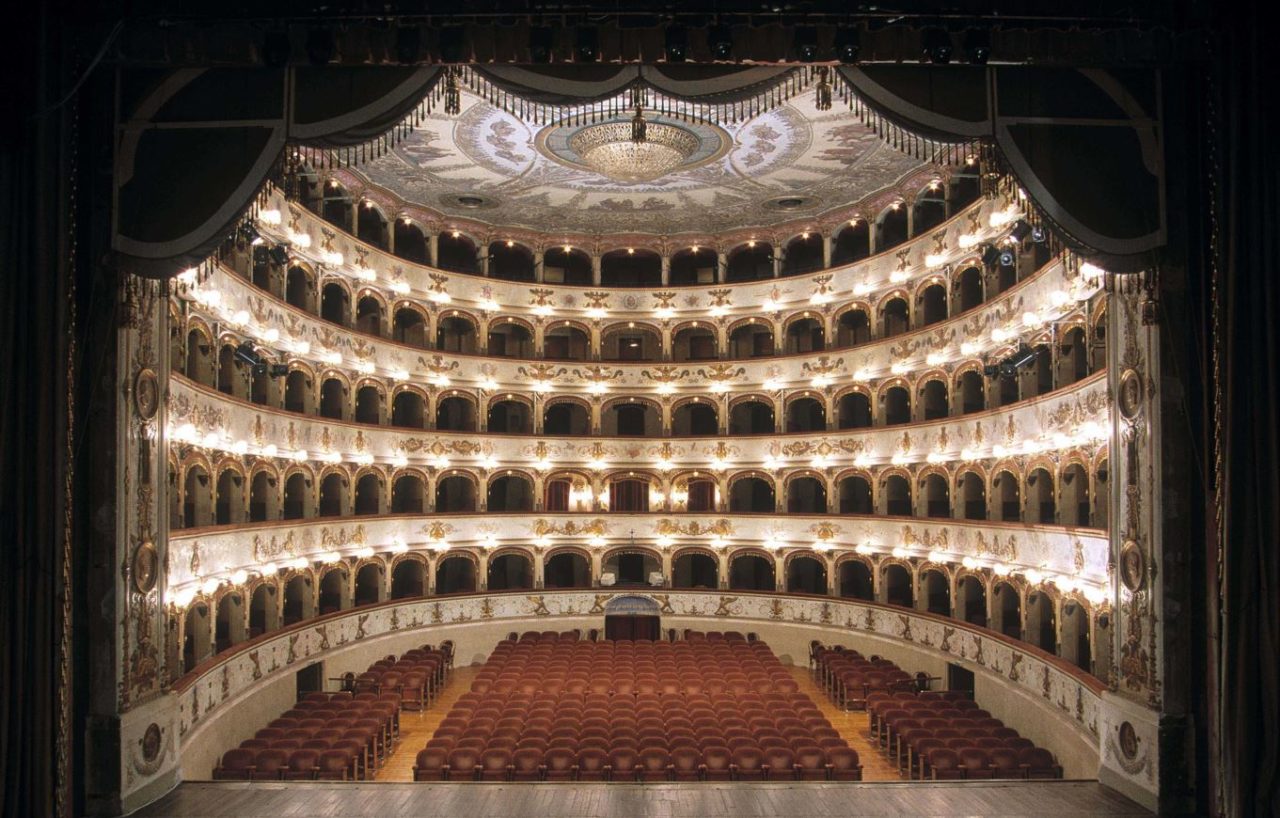
MUNICIPAL THEATER OF FERRARA
Considered one of the most beautiful examples of Italian-style theatre, the Municipal Theatre of Ferrara was built between 1773 and 1797, designed by Antonio Foschini and Cosimo Morelli, and inaugurated in 1798 with the opera Gli Orazi e i Curiazi by Marco Portogallo. It is located on Corso Martiri della Libertà, in the historic center just a few meters from the Estense Castle. On March 21, 2014, the theatre was dedicated to the memory of Claudio Abbado, founder of Ferrara Musica and a key figure in the city of Ferrara for 25 years with memorable operas and concerts.


