
VIDEO NO LONGER AVAILABLE
Aroldo
Music by Giuseppe Verdi
Melodrama in four acts
Libretto by Francesco Maria Piave, adaptation of Stiffelio
Aroldo Antonio Corianò
Mina Lidia Fridman
Egberto Michele Govi
Briano Adriano Gramigni
Godvino Cristiano Olivieri
Enrico Davide Capitanio
A lecturer Ivano Marescotti
Dramaturgy and Direction Emilio Sala and Edoardo Sanchi
Stage movements Isa Traversi
Sets Giulia Bruschi
Lighting Nevio Cavina
Video editing and projections Matteo Castiglioni
Costumes Elisa Serpilli and Raffaella Giraldi
Pictorial restoration of the historical curtain by Francesco Coghetti Maria Grazia Cervetti and Rinaldo Rinaldi
Assistant to the sets Riccardo Mainetti
LUIGI CHERUBINI YOUTH ORCHESTRA
Conductor Manlio Benzi
CHORUS OF THE MUNICIPAL THEATER OF PIACENZA
Chorus Master Corrado Casati
NEW PRODUCTION
in co-production with Teatro Galli of Rimini, Teatro Alighieri of Ravenna, Teatro Comunale of Modena, Teatro Municipale of Piacenza
Verdi’s Aroldo was first performed on August 16, 1857, to inaugurate the New Theater of Rimini, which, designed by architect Luigi Poletti, finally opened its doors in July of the same year after long difficulties. For that occasion, the theater was also equipped with a large curtain created by the Bergamo painter Francesco Coghetti on the theme of Julius Caesar crossing the Rubicon. The scene depicts the moment when, at night, Caesar on his horse crosses the stream, challenging the Roman state. In the dark sky appears
the image of the troubled Homeland (“patriae trepidantis imago,” as Lucan wrote in the Pharsalia) warning the unyielding leader. Moreover, there are not enough elements to determine whether the current Rubicon, which until the late 1920s was instead called Fiumicino, corresponds to the watercourse to which the Romans gave that name. We only know that the ancient Rubicon flowed between the cities of Cesena and Rimini, in whose territory there are some streams called Fiumicino, Pisciatello, and Uso. It was only in 1932 that the ancient name was restored by Mussolini by decree: from that year, Fiumicino was renamed Rubicon as part of an ideological campaign based on the identification between the Duce and the founder of the Roman Empire. Returning to 1857, Verdi and Giuseppina Strepponi, along with the librettist and stage director Francesco Maria Piave, spent about a month in Rimini. Aroldo was conducted by Angelo Mariani, and the main roles were entrusted to the following performers: Aroldo to Emilio Pancani (27 years old), Mina to Marcella Lotti della Santa (26 years old), Egberto to Gaetano Ferri, Godvino to Salvatore Poggiali, and Briano to Giovanni Battista Cornago.
The Theater of Rimini was, after the Unification, named after the first king of Italy, Vittorio Emanuele II, and continued to play its role as the leading institution of the city’s theatrical and musical life until, during World War II, it was hit in the disastrous air raid of December 28, 1943, one of the most devastating that the already semi-destroyed seaside city suffered. After the war and the fall of fascism, the City Council, in a resolution of 1947, on the one hand, decided not to rebuild the theater, on the other hand, decided to rename it after the Rimini musician Amintore Galli. The building remained, like an open wound in the heart of the city, for seventy-five years. During this long period, every attempt to promote its reconstruction ended in nothing, marked by controversies as fierce as they were inconclusive. Then the miracle. In 1995, the curtain that had been recovered from the rubble after the bombing by the theater’s custodian Aldo Martinini was unrolled in public for the first time. Although torn and degraded, the large canvas struck the imagination of the people of Rimini, triggering a process of collective awareness that led to the formation of a movement of opinion whose determination was joined by a new political will that broke through to the municipal administration.
In 2018, the Amintore Galli Theater of Rimini, rebuilt based on the Poletti project, was returned to the city and to the entire community of those who recognize themselves in the values of culture and art.
The new production of Aroldo, which will be staged on August 27 and 29, 2021, in the same theater that first hosted it, re-proposes Verdi’s opera in a production that, in addition to the original story, will tell the story of the Rimini theater, or, as will be discovered in the end, our story. The starting point is the “drama of forgiveness” which – a rare case – is at the basis of Verdi’s musical project, a dramaturgy that, in the same year (1857), had already been experimented by the great composer in Simon Boccanegra, albeit with a tragic outcome: Fiesco and Simone reconcile, but the latter dies poisoned. In Aroldo, however, the final forgiveness opens a cathartic space – however fragile – full of expectations and hope.
Emilio Sala
EXTRA
LIVE FROM.
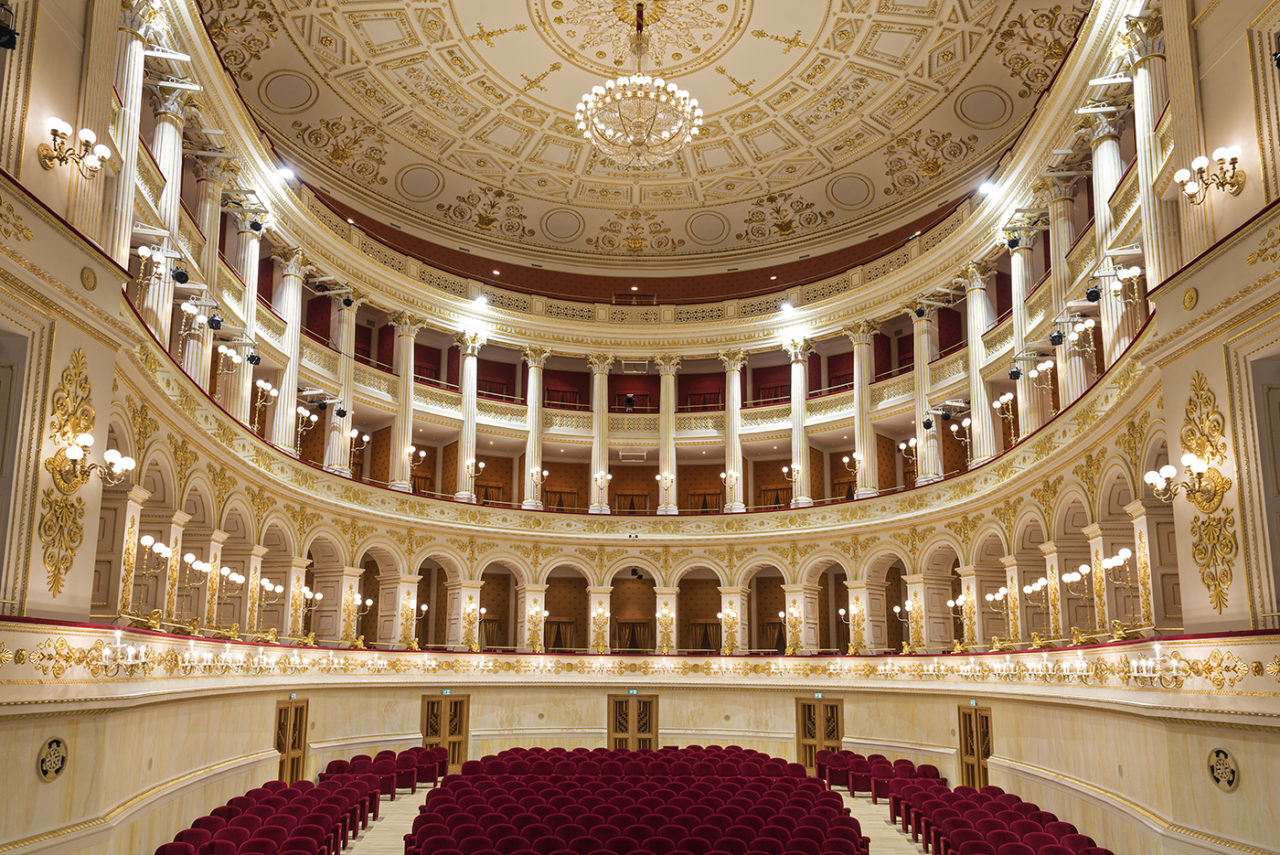
GALLI THEATRE RIMINI
Erected between 1843 and 1856, the Amintore Galli Theater was inaugurated in 1857 with the first performance of Giuseppe Verdi’s Aroldo. The project and neoclassical style were designed by Luigi Poletti, an architect and engineer of the Papal States. Originally called the “New Theater,” it changed its name in 1859 to Vittorio Emanuele II Theater. Only later, in 1947, was it dedicated to the composer Amintore Galli (1845-1919). The theater’s activity was interrupted in 1943 when the building was severely destroyed by World War II bombings: the auditorium and stage collapsed, while the foyer remained almost intact.
On October 28, 2018, after 75 years of silence, the theater was reopened to the public, welcomed by the extraordinary voice of one of the world’s opera stars, Cecilia Bartoli. The inaugural program continued for three months, with special events such as the theatrical performance of Giuseppe Verdi’s Simon Boccanegra, conducted by Valerij Gergiev with the orchestra of the Mariinsky Theater of St. Petersburg, and the show by world-renowned dance artist Roberto Bolle, Roberto Bolle and Friends.


