

VIDEO NO LONGER AVAILABLE
Gala Giuseppe Verdi
Famous pieces from Don Carlo, A Masked Ball, The Force of Destiny and Othello
Tenor Francesco Meli
Baritone Luca Salsi
Piano Davide Cavalli
“And then we emerged to see the stars again” , Summer Festival 2020, Palazzo Farnese
Opening concert curated by the Teatro Municipale of Piacenza
Production
Fondazione Teatri di Piacenza
Organized by the Fondazione Teatri di Piacenza and the Municipality of Piacenza, the inaugural event of the summer festival “And then we emerged to see the stars again” will be an extraordinary Verdian Gala featuring two of the brightest stars in opera: tenor Francesco Meli and baritone Luca Salsi, performing together for the first time in concert accompanied on piano by Davide Cavalli.
In the open-air space of Palazzo Farnese, arranged with the utmost attention to health safety regulations, with a capacity of about 300 seats, famous pieces from Giuseppe Verdi’s operas Don Carlo, La forza del destino, and Otello will resonate, in an event of highly symbolic value to celebrate the rebirth of music and culture after a dark period, in one of the cities most affected by the pandemic.
Francesco Meli is one of the most captivating and sought-after tenors in the world. He has sung in solo recitals at La Scala, London, Tokyo, and St. Petersburg, in Verdi’s Requiem with Riccardo Chailly, Daniele Gatti, Fabio Luisi, Riccardo Muti, Lorin Maazel, Gianandrea Noseda, and Yuri Temirkanov at La Scala, London, Paris, Zurich, Moscow, Salzburg, St. Petersburg, Tokyo, and Vienna. In 2019, singing again in the Requiem conducted by Muti, he performed for the first time with the Berliner Philharmoniker during the Easter Festival in Baden-Baden. He won the Abbiati Prize in 2013 for his Verdi interpretations, the Golden Mask, the Opera Oscar, the Zenatello Prize at the Arena di Verona, the Orazio Tosi Prize, the Carlo Alberto Cappelli Prize, the Pertile Prize, the Lugo Prize, the Prandelli Prize, the Mascagni Prize, the Golden Tiberini, the Golden ISO, and the Labò Plaque. Among his most recent engagements, Simon Boccanegra in London, Genoa, and Vienna, Ernani and La Traviata at La Scala, Verdi’s Requiem conducted by Riccardo Muti in Tokyo, Baden-Baden, and at the Salzburg Festival, Aida at Teatro La Fenice, Aida in concert form in Chicago with the Chicago Symphony Orchestra conducted by Muti. The 2019/2020 season includes the Verdi Opera Gala in Piacenza, Giovanna d’Arco in concert at La Monnaie, Ernani in concert in Lyon, Paris, and Vichy, Verdi’s Requiem conducted by Muti with the Chicago Symphony Orchestra at the Musikverein in Vienna. He opened the current season at La Scala, singing as Caravadossi in Tosca, under the direction of Riccardo Chailly and with the staging by David Livermore. On February 23, 2020, when the Teatro alla Scala was closed due to the coronavirus, he was engaged there with Il Trovatore, another of his signature roles, which he would have celebrated with his 50th performance during one of the February shows.

He made his debut at La Scala at just 23 years old in Les Dialogues des Carmelites conducted by Maestro Riccardo Muti, and returned in subsequent years for Otello, Idomeneo, Don Giovanni, Maria Stuarda, and Der Rosenkavalier. To date, Francesco Meli boasts eighteen different posters at La Scala in Milan. In 2004, he debuted as Nemorino in L’elisir d’amore, subsequently singing the role in numerous theaters. Starting in 2005, he opened the season at Carlo Felice in Don Giovanni and the Rossini Opera Festival with a new production of Bianca e Falliero. He sang in Il Barbiere di Siviglia in Zurich, in Don Giovanni at the Théâtre des Champs-Elysées in Paris, La Sonnambula in Lyon for a Virgin recording alongside Natalie Dessay, in Così fan tutte in Vienna conducted by Riccardo Muti, where he later returned for a new production of Anna Bolena, Maometto II at the Rossini Opera Festival and in Tokyo, Torvaldo e Dorliska again in Pesaro for the opening of the Festival in 2006, then the Duke of Mantua for his debuts at the Royal Opera House and the Metropolitan Opera House in New York.
Praised by «Sole 24 ORE» for “a voice so beautiful that it stands out in the stage melee: incisive, full, rounded, powerful, and fresh,” Luca Salsi was born in San Secondo Parmense. He graduated in singing from the Conservatorio “Arrigo Boito” in Parma, under the guidance of soprano Lucetta Bizza, further refining his skills with baritone Carlo Meliciani. His career has seen him perform on the world’s major stages: the Metropolitan in New York, Teatro alla Scala, the Royal Opera House in London, the Bayerische Staatsoper, the Washington National Opera, the Salzburg Festival, the Los Angeles Opera, the Staatsoper in Berlin, the Liceu de Barcelona, the Teatro del Maggio Musicale Fiorentino, the Teatro dell’Opera di Roma, the Teatro San Carlo in Naples, the Concertgebouw in Amsterdam, and the Teatro Real in Madrid. He has collaborated with important conductors such as Riccardo Muti, Riccardo Chailly, Valery Gergiev, James Levine, Daniele Gatti, James Conlon, Gustavo Dudamel, Nicola Luisotti, Renato Palumbo, Donato Renzetti, Michele Mariotti, and Alberto Zedda, as well as with prestigious directors like Robert Carsen, Hugo De Ana, Antony Minghella, Werner Herzog, Franco Zeffirelli, David McVicar, and Damiano Michieletto.

He was the protagonist of two season openings at Teatro alla Scala: in 2017 in Andrea Chénier and in 2019 in Tosca, on both occasions alongside Anna Netrebko and under the direction of Riccardo Chailly. He also opened the Verdi Festival in Parma in Macbeth and the 2018/19 season of Teatro La Fenice, again in the role of Macbeth (with direction by Damiano Michieletto and conducted by Myung-whun Chung). He debuted as Iago in Otello with the Berliner Philharmoniker and was Macbeth under the direction of Riccardo Muti (Florence and Ravenna), Rodrigo in Don Carlo at Teatro Comunale di Bologna and for the opening of Teatro Real in Madrid, Carlo in Ernani at Teatro alla Scala, Germont in La traviata and Scarpia in Tosca at the Opéra de Paris, Nabucco and Gérard in Andrea Chénier at the Wiener Staatsoper, Simon Boccanegra at the Salzburg Festival (with Valery Gergiev on the podium of the Wiener Philharmoniker), and once again Germont in La traviata at the Metropolitan Opera in New York. In February 2020, he debuted as Alfio in Cavalleria rusticana with the Chicago Symphony Orchestra conducted by Riccardo Muti.
Since 2015, Davide Cavalli has been a pianist at the Riccardo Muti Italian Opera Academy. In August 2017, he was a rehearsal pianist and musical assistant for the production of Giuseppe Verdi’s Aida at the Salzburg Festival conducted by Riccardo Muti with Anna Netrebko, Francesco Meli, Ekaterina Semenchuk, and Luca Salsi in the leading roles. In December 2018, he performed in the inaugural program of Teatro Amintore Galli in Rimini, reopened after 75 years. On April 6, 2019, together with Francesco Meli, he performed in Rome, at Palazzo Madama, in the Senate & Culture series on the occasion of the lifetime achievement award presented by the President of the Senate to Franco Zeffirelli.

He began his piano studies with Alfredo Speranza, graduating with top honors from the Conservatorio Luisa D’Annunzio in Pescara. He later attended advanced courses with Edith Fischer, Robert Szidon, Aquiles Delle Vigne, and Pier Narciso Masi and obtained, with top honors, the Second Level Academic Diplomas in Musical Disciplines in the Piano class of Roberto Cappello and in the Chamber Music class of Pierpaolo Maurizzi, at the Conservatorio Arrigo Boito in Parma.
An eclectic musician, he has performed as a soloist and in chamber ensembles at prestigious musical institutions such as the Odessa Philharmonic Society, the Hindemith Foundation in Blonay, the Conservatorio della Svizzera Italiana in Lugano, the Geneva Conservatory, the Ravenna Festival, the Milan Conservatory, the Conservatorio di Città Reale, the Schubert Club of Saint Paul, and the University of Minnesota. He has also given concerts at the Église de Saanen and the Auditorium Kirchgemeindehaus in Gstaadt, the Eglise Saint Marc in Brussels, the Salle des Arts in Paris, the Sala Joaquín Turina in Seville, the Teatro Regio and the Auditorium Paganini in Parma, the Teatro Alighieri in Ravenna, the Palacultura in Messina, the Teatro Verdi in Pisa, in Prague, Barcelona, Des Moines (Iowa), Milwaukee, Philadelphia. As part of the Internationales Kammermusik Festival Austria, he recorded for Austrian radio and television (ORF) at the Stift Altenburg Bibliothek, together with Davide Muccioli, the Suites for piano duo by Sergei Rachmaninoff. He is the absolute winner of the Seiler Piano Competition in Crete, the Frédéric Chopin Competition in Rome, and the Camillo Togni Competition in Brescia. He has also won the first absolute prize in numerous national piano competitions. He is actively involved in musical theater, collaborating, among others, with the Salzburg Festival, the Ravenna Festival, the Teatro dell’Opera di Roma, with conductors Riccardo Muti, Patrick Fournillier, Ottavio Dantone, Andrea Battistoni, Boris Brott, Nicola Paszkowski, Stefano Montanari, Maurizio Zanini, and with directors Graham Vick, Pier Luigi Pizzi, Cristina Mazzavillani Muti, Micha van Hoecke, Chiara Muti, Shirin Neshat, Cesare Lievi, Emilio Sagi, Michele Mirabella, Andrea De Rosa… He collaborates with the Luigi Cherubini Youth Orchestra and has participated in the tours of I Due Figaro by Saverio Mercadante at Teatro Colón in Buenos Aires, Il Trovatore at the Royal Opera House in Muscat in Oman, Rigoletto at the Bahrain National Theatre, Falstaff and Macbeth at the Savonlinna Opera Festival in Finland, and the Le vie dell’Amicizia concerts conducted by Riccardo Muti in Kiev, Tehran, and Athens.
On December 19, 2014, on the tenth anniversary of Renata Tebaldi’s death, he performed Gioachino Rossini’s Petite Messe Solennelle in the Basilica of San Marino. On the occasion of the bicentenary celebrations of Giuseppe Verdi’s birth, he participated in the project Echi notturni di incanti verdiani in collaboration with Rai 1, at the Maestro’s birthplace in Roncole di Busseto, creating the musical arrangement of the death scenes of the heroines of the Trilogia popolare. He is a Piano Professor at the Antonio Canova Music High School in Forlì. (June 2020)
EXTRA
LIVE FROM.
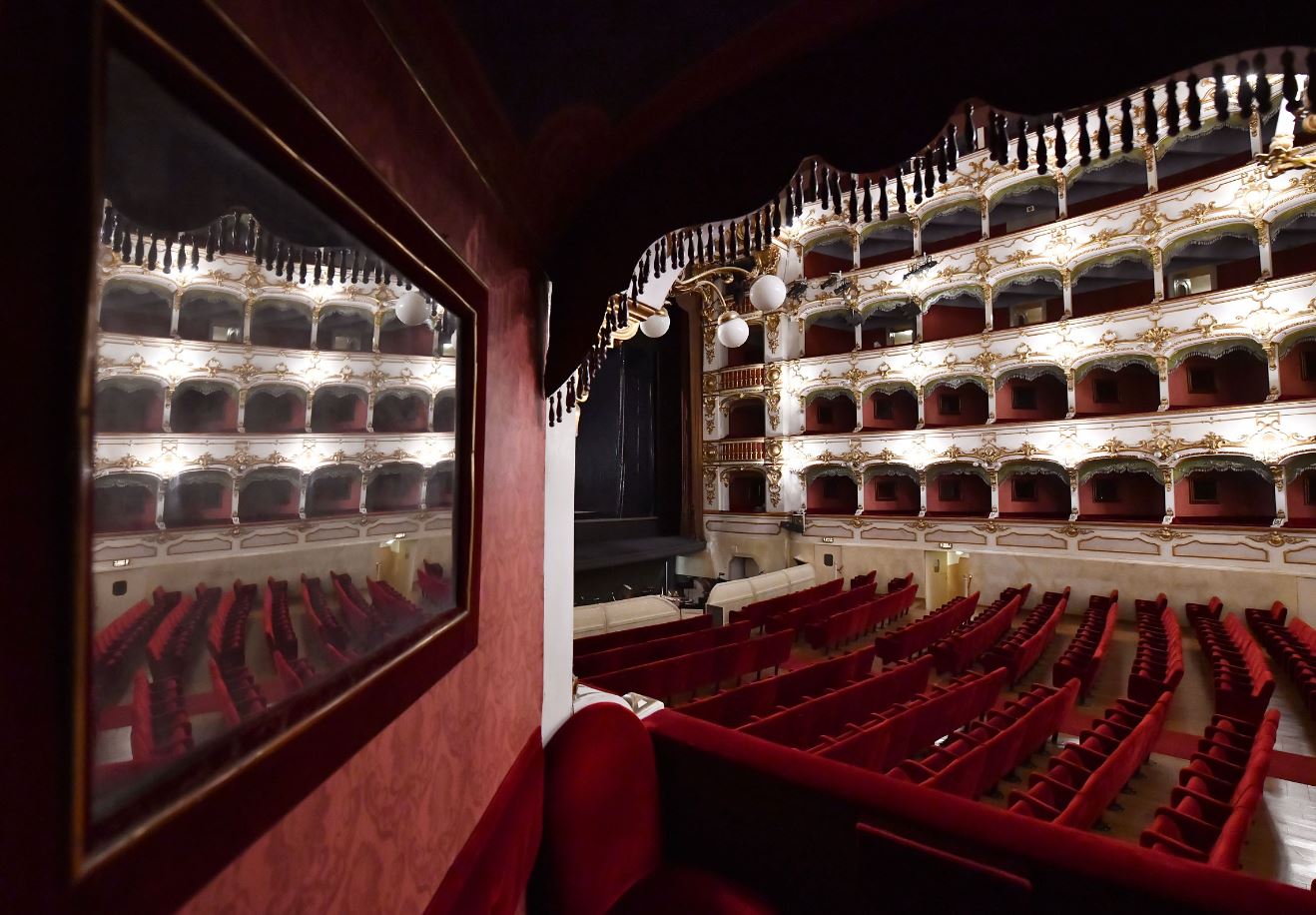
MUNICIPAL THEATRE OF PIACENZA
A splendid example of late 18th-century architecture, Piacenza’s Municipal Theater was inaugurated on September 10, 1804, with Zamori, or Hero of the Indies, a dramma serio for music by Giovanni Simone Mayr, a Bavarian musician who was Gaetano Donizetti’s teacher and who lived for a long time in Bergamo.
Construction of the theater, designed by Piacenza architect Lotario Tomba (author, among other things, of the Governor’s Palace in Piazza Cavalli) began in September 1803 and was completed the following year.
Piacenza was the first city in Emilia to have a new, modernly conceived, capacious and, above all, beautiful theater; Parma would have it in 1829, Modena in 1838, Reggio Emilia in 1857.


