

VIDEO NO LONGER AVAILABLE
The Barber of Seville
Music by Gioachino Rossini
Comic opera in two acts
Libretto by Cesare Sterbini
from the play of the same name by Pierre-Augustin Caron de Beaumarchais
Count Almaviva Manuel Amati
Don Bartolo Marco Filippo Romano
Rosina Giuseppina Bridelli
Figaro Roberto De Candia
Don Basilio Mattia Denti
Berta Stefania Ferrari
Fiorello Francesco Cascione
Ambrogio Michele Zaccaria
An officer Simone Tansini
Conductor Nikolas Nägele
Director Beppe De Tomasi
revived by Renato Bonajuto
SetsPoppi Ranchetti
CostumesArtemio Cabassi
Lighting Michele Cremona
ORCHESTRA DELL’EMILIA-ROMAGNA ARTURO TOSCANINI
CHORUS OF THE MUNICIPAL THEATER OF PIACENZA
Chorus master Corrado Casati
in co-production with Teatro Regio di Parma, Teatro Municipale di Piacenza
Production of Teatro Regio di Parma
The Municipal Theater of Piacenza does not stop: despite the closure to the public imposed by measures to contain the pandemic, it chooses to stream the production of The Barber of Seville by Gioachino Rossini. The show, recorded behind closed doors these days at the Municipal Theater with the utmost attention to health safety regulations for artists and staff, will be broadcast in streaming premiere on Sunday, December 20 at 3:30 PM, free of charge and worldwide on YouTube, thanks to the support of Opera Streaming, the first regional portal dedicated to the transmission of opera, where it will remain available afterwards.
In the period traditionally dedicated to the inauguration of the Piacenza Opera Season, the famous Rossini title, a co-production of the Fondazione Teatro Regio di Parma and the Fondazione Teatri di Piacenza, will be staged in the classic and elegant production signed in 2005 for the Regio di Parma by the Master of direction Beppe De Tomasi, revived by Renato Bonajuto, who describes his work revised in light of the anti-Covid rules as follows: “A new way to which the performers of this dynamic company have lent themselves with professionalism and enthusiasm – explains Bonajuto in the director’s notes – putting themselves to the test, experimenting with new solutions, new languages that reached the audience even through the new technological tool of streaming, respecting the comic character desired by the composer.”
The conductor and director will be Nikolas Nägele, Kapellmeister at the Deutsche Oper Berlin, leading the Orchestra dell’Emilia-Romagna Arturo Toscanini and the Chorus of the Municipal Theater of Piacenza prepared by Corrado Casati.
A new cast featuring young singers and specialists in the Rossini repertoire: the twenty-three-year-old tenor Manuel Amati (Count Almaviva), the mezzo-soprano Giuseppina Bridelli making her debut in the role of Rosina, returning to the Municipal Theater after Aci, Galatea e Polifemo by Händel, the internationally renowned baritone Roberto de Candia (Figaro), the baritone Marco Filippo Romano (Don Bartolo), another welcome return to the Municipal Theater after La Cenerentola and La forza del destino, as well as the bass Mattia Denti (Don Basilio), a native of Piacenza like Stefania Ferrari (Berta), Simone Tansini (Officer) and Bridelli herself, in the spirit of continuous attention to local artists, and the baritone Francesco Cascione (Fiorello). The sets are by Poppi Ranchetti, the costumes by Artemio Cabassi, and the lighting by Michele Cremona.
Composed for the Teatro Argentina in Rome in 1816, the opera is inspired by the comedy Le Barbier de Séville ou La précaution inutile by Pierre-Augustin Caron de Beaumarchais, already set to music thirty-four years earlier by Giovanni Paisiello. Perhaps it was precisely the prejudices of Paisiello’s supporters that led to the protests that greeted its debut. However, the failure lasted only one day: already after the premiere, the success of the opera grew rapidly and within a few years it was performed throughout Europe. Its fortune has never waned, establishing The Barber of Seville as the most well-known and performed opera of the comic genre.
EXTRA
LIVE FROM.
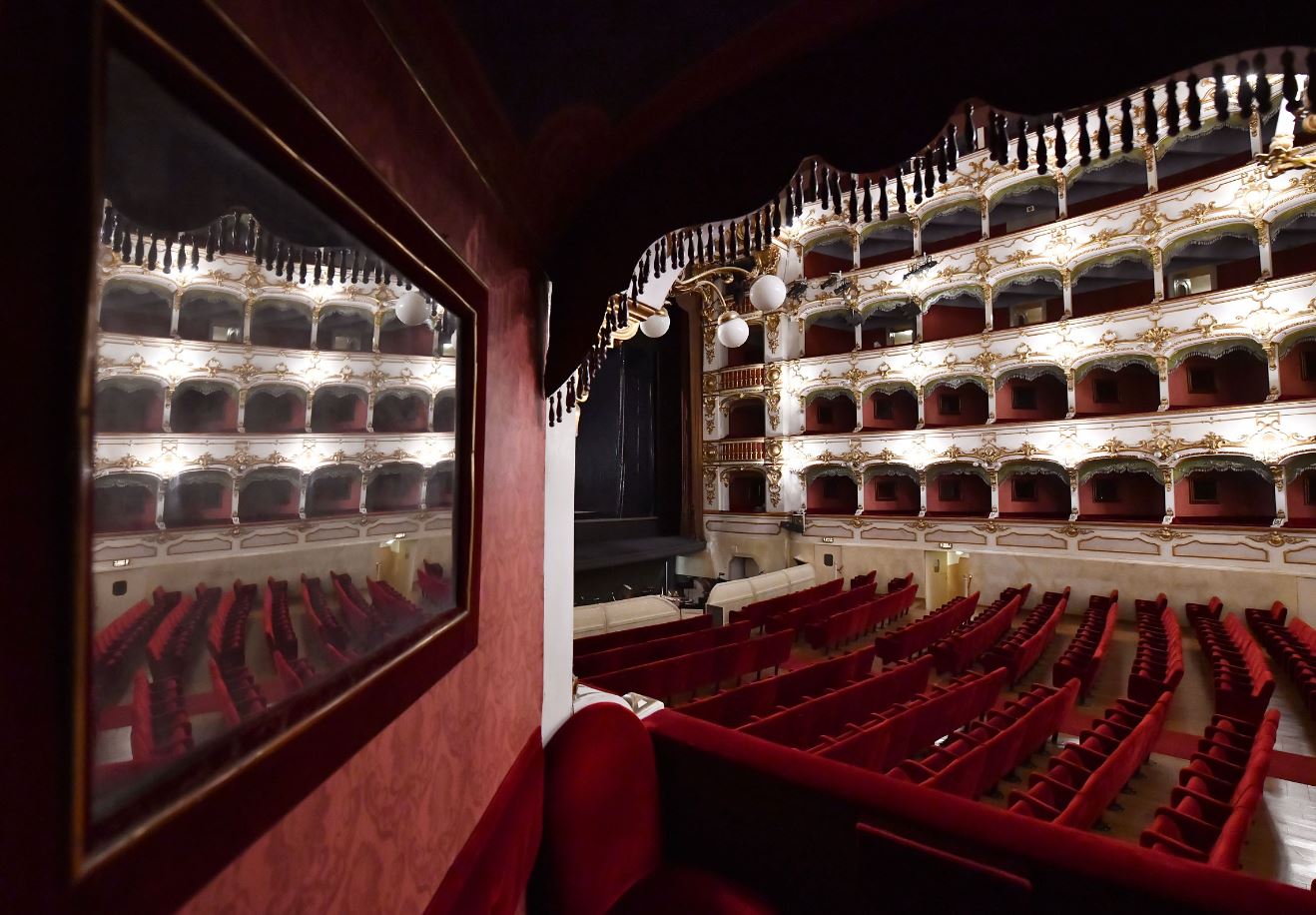
MUNICIPAL THEATRE OF PIACENZA
A splendid example of late 18th-century architecture, Piacenza’s Municipal Theater was inaugurated on September 10, 1804, with Zamori, or Hero of the Indies, a dramma serio for music by Giovanni Simone Mayr, a Bavarian musician who was Gaetano Donizetti’s teacher and who lived for a long time in Bergamo.
Construction of the theater, designed by Piacenza architect Lotario Tomba (author, among other things, of the Governor’s Palace in Piazza Cavalli) began in September 1803 and was completed the following year.
Piacenza was the first city in Emilia to have a new, modernly conceived, capacious and, above all, beautiful theater; Parma would have it in 1829, Modena in 1838, Reggio Emilia in 1857.


