
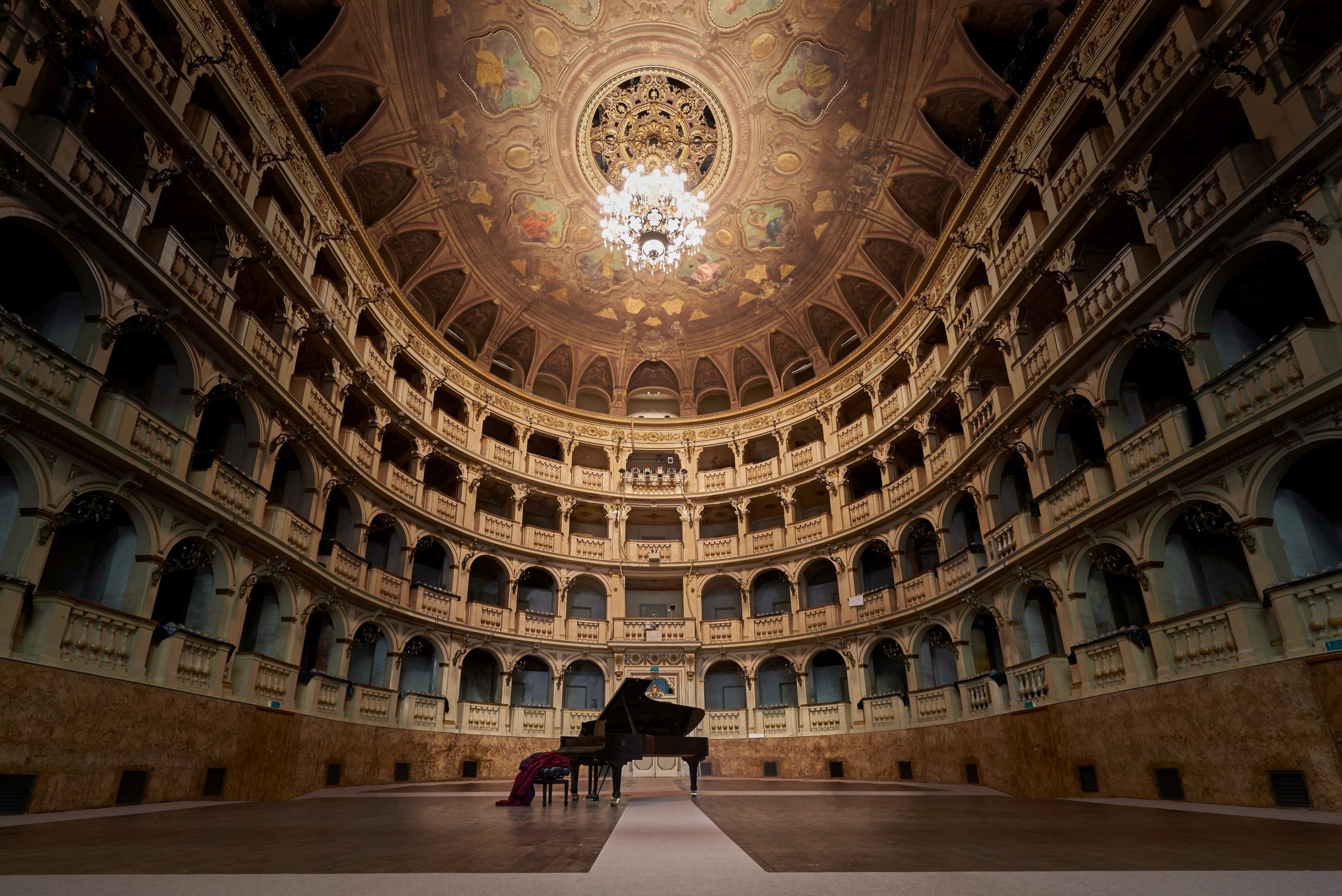
The Teatro Comunale di Bologna was officially established on May 14, 1763, with the world premiere of Christoph Willibald Gluck’s Trionfo di Clelia.
The building is one of the first masonry constructions, strategically located in a key area of the urban fabric, symbolizing the intention to make performance venues permanent, considered icons of a collective identity. Today, the theater is a Foundation and produces about a hundred performances a year, distributed between the Sala del Bibiena and the auditorium of the Teatro Manzoni, where the symphonic season takes place.
Built to host Italian melodrama, the Teatro Comunale carries with it not only its own history but also the entire history of the city that hosts it, in the place where the splendid Palazzo dei Bentivoglio was once admired. From the beginning, the Comunale established itself as the major theater of a city that, from the late 17th century until the triumph of Casa Ricordi and industrial publishing, played the role of the capital of the Italian opera production system. The theater has dominated, from its inception, the fabric of a city that was home to an impressive number of agents, impresarios, singers, dancers, instrumentalists, designers, and scene and costume renters, as well as the influential Accademia Filarmonica, which, among others, graduated a fourteen-year-old Wolfgang Amadeus Mozart under the guidance of Padre Martini.
The Teatro Comunale di Bologna has always been at the center of the city’s life not only for its productive role, making it one of the most important theaters in Italy, but also for its “strategic” location, making it a fundamental piece in the heart of Bologna’s cultural and urban structure, given its proximity to the Institute of Sciences, the Accademia Clementina, the University (the oldest university in Europe), the Pinacoteca, and the Academy of Fine Arts, as well as the former convent of San Giacomo, home to the Conservatory “Giovan Battista Martini,” which trained, among its first students, Gioachino Rossini and Gaetano Donizetti.
CHORUS
Among the most renowned choral ensembles on the international scene, its leadership has included Gaetano Riccitelli, Leone Magiera, Fulvio Fogliazza, Fulvio Angius, Piero Monti, Marcello Seminara, Paolo Vero, Lorenzo Fratini, Andrea Faidutti, and since 2019, Alberto Malazzi. Numerous recordings include La Favorita, Macbeth, Manon Lescaut, Rigoletto, La Cenerentola, and Rossini’s Messa Solenne. Among the numerous international appearances are Amsterdam (1987), Wiesbaden (1994), Japan (1993, 1998, 2002, 2006, 2011, 2017), Savonlinna (2006), Santander (2008), Muscat (2015), Paris (2018). In 2001, it participated in Verdi’s Requiem Mass at the Royal Albert Hall in London for the BBC Proms Festival, with the Royal Philharmonic Orchestra conducted by Daniele Gatti. In June 2019, the Chorus will be on tour again in Japan (Osaka, Tokyo, Yokohama, Fukuoka), with Rigoletto directed by Alessio Pizzech and The Barber of Seville directed by Federico Grazzini.
Of significant importance is the return to the Rossini Opera Festival from 2009 to 2016, during which in 2011 it participated in Moses in Egypt directed by Graham Vick and conducted by Roberto Abbado, a production that won the “Abbiati” award for best show of the year.
In 2017, the Chorus participated in the Verdi Festival in Parma in La Traviata and Stiffelio by Graham Vick, staged at the Teatro Farnese and awarded the special “Franco Abbiati” Prize.
The Chorus’s autumn 2019 commitments for the Verdi Festival include Luisa Miller at the Church of San Francesco del Prato in Parma and Aida at the Teatro Verdi in Busseto.
In 2018, the Teatro Comunale’s production of La bohème by Graham Vick won the Abbiati Prize for best show.
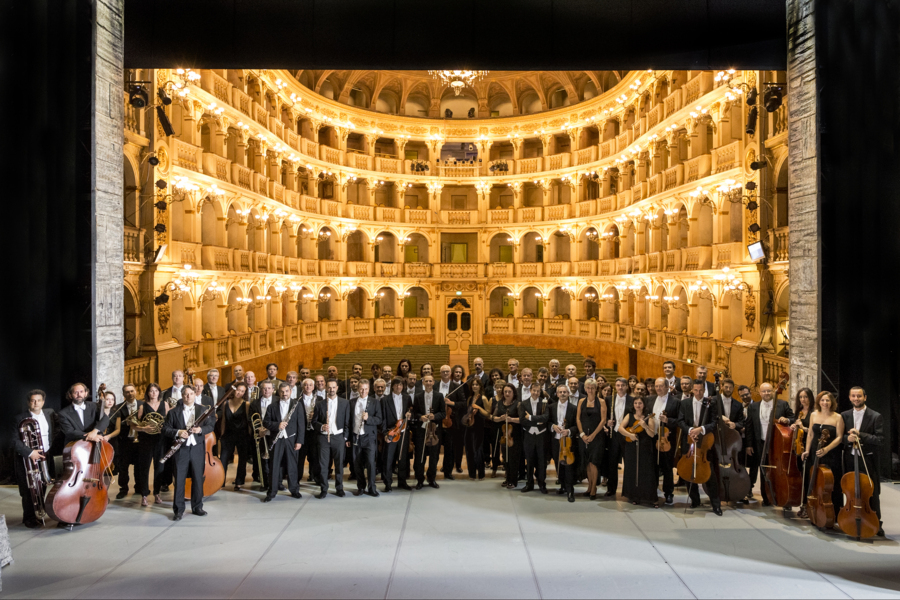
ORCHESTRA
An orchestra with a great tradition, its musical directors have included Sergiu Celibidache, Zoltán Peskó, Vladimir Delman, Riccardo Chailly, Daniele Gatti, Michele Mariotti. Among the conductors who have led the ensemble are Gary Bertini, Myung-Whun Chung, James Conlon, Pinchas Steinberg, Valery Gergiev, Eliau Inbal, Vladimir Jurowski, Daniel Oren, Peter Maag, Neville Marriner, Kurt Masur, Riccardo Muti, Mstislav Rostropovich, Esa-Pekka Salonen, Georg Solti, Christian Thielemann, Charles Dutoit, Georges Prêtre. The Orchestra of the Teatro Comunale is frequently invited abroad (Netherlands, Romania, Spain, France, and Switzerland) and has participated in prestigious festivals (Amsterdam 1987, Parma 1990, Wiesbaden 1994, Santander 2004 and 2008, Aix en Provence 2005, Savonlinna 2006, Macau 2013, Muscat 2015, Guanajuato in Mexico 2017, Paris 2018). A special relationship with Japan has led to several tours, the most recent in June 2019 in Osaka, Tokyo, Yokohama, Fukuoka, with Rigoletto directed by Alessio Pizzech and The Barber of Seville directed by Federico Grazzini.
Numerous recordings include La Favorita conducted by Richard Bonynge, Oberto Conte di San Bonifacio conducted by Zoltán Peskó, The Barber of Seville conducted by Giuseppe Patané, The Daughter of the Regiment conducted by Bruno Campanella, Le Maschere and La Bohème conducted by Gianluigi Gelmetti, La Scala di Seta conducted by Gabriele Ferro, Macbeth, Manon Lescaut, Rigoletto, La Cenerentola, Messa Solenne, and video productions of I Vespri Siciliani and Giovanna d’Arco and Werther conducted by Riccardo Chailly, Armida conducted by Daniele Gatti, Simon Boccanegra conducted by Michele Mariotti.
The Orchestra, led by Michele Mariotti, recorded for Decca a CD of sacred arias with Juan Diego Flórez and for Sony an album of romantic arias with Nino Machaidze. For Deutsche Grammophon, Le Comte Ory with Flórez and La Nuit de Mai, opera arias and songs by Leoncavallo, with Placido Domingo. Recently released by the PENTATONE label, a CD of Rossini overtures to celebrate the 150th anniversary of the composer’s death.
In March 2013, the artistic bodies of the Teatro Comunale di Bologna, conducted by Michele Mariotti, were the protagonists of the inaugural concert of the IV Mstislav Rostropovich International Festival in Moscow, performing Verdi’s Requiem Mass. In October 2015, again with Michele Mariotti on the podium, they inaugurated the Lingotto Musica series at the Auditorium Giovanni Agnelli in Turin, where they performed the Stabat Mater, the Overture, and the Dances from Rossini’s Guillaume Tell.
After a thirty-year participation in the Rossini Opera Festival (from 1988 to 2016), 2017 marked a new collaboration between the Teatro Comunale di Bologna and the Verdi Festival in Parma, which, among various productions, saw the Orchestra engaged in Stiffelio directed by Graham Vick. Staged at the Teatro Farnese, it achieved great success with audiences and critics, winning the Special Prize of the 37th “Franco Abbiati” Musical Critics Award. The Orchestra’s autumn 2019 commitments for the Verdi Festival include Luisa Miller at the Church of San Francesco del Prato in Parma and Aida at the Teatro Verdi in Busseto.
In 2018, the Teatro Comunale’s production of La bohème by Graham Vick won the Abbiati Prize for best show.
BOLOGNA
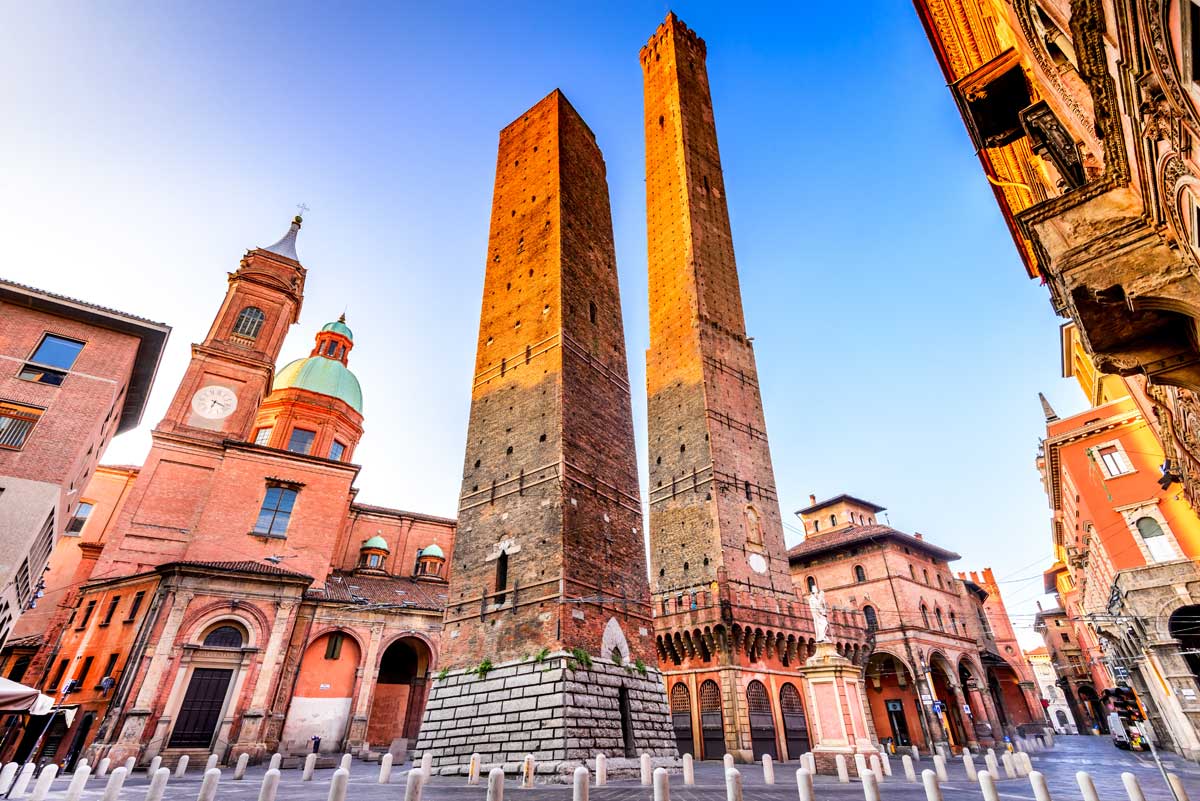
Home to the oldest university in the Western world, Bologna is a city with an intense cultural life and a very interesting historical heritage. Bologna was also a prominent urban center in Europe during the Middle Ages.
European Capital of Culture in 2000, in 2006 it was declared a UNESCO “City of Music.”
The most important symbols of Bologna are its characteristic porticoes, or covered walkways, and its towers, which offer tourists the opportunity to admire a wonderful panorama from above.


