

LIVE STREAMING FEBRUARY 28, 2021 - 3:30 PM (CANCELLED SHOW RESCHEDULED FOR 2021)
conductor Ottavio Dantone
direction, sets, and costumes Pier Luigi Pizzi
Accademia Bizantina
Coro Costanzo Porta
choir master Antonio Greco
GIULIO CESARE: HÄNDEL OPENS THE OPERA SEASON AT THE TEATRO ALIGHIERI IN RAVENNA
A metaphysical space, whose hues recall the gold of the sands and precious metals of Egypt and the enigmatic faces of the pharaohs’ masks: this is how Chiara Muti’s direction envisions the new production of Händel’s Giulio Cesare. Following the 2023 Tamerlano and the 2024 Autumn Trilogy, the successful collaboration with Accademia Bizantina and Ottavio Dantone continues to bring the 17th and early 18th-century melodramatic repertoire, less frequented than that of later centuries, to the stage at Teatro Alighieri.
The role of Giulio Cesare has been entrusted to Raffaele Pe, while Cleopatra is played by Marie Lys. Delphine Galou takes on the role of Pompeo’s wife, Cornelia, while Tolomeo, Cleopatra’s brother and rival for the Egyptian throne, is portrayed by Filippo Mineccia. The cast is completed by Davide Giangregorio as Achilla, Federico Fiorio as Sesto, Andrea Gavagnin as Nireno, and Clemente Antonio Daliotti as Curio. Alessandro Camera designs the sets, Tommaso Lagattolla is responsible for the costumes, and Vincent Longuemare handles the lighting. After its debut in Ravenna, the new production will tour the co-producing theaters – namely Modena, Piacenza, Reggio Emilia, Lucca, and Bolzano.
“Giulio Cesare is an opera that everyone should know, as it represents the perfect symbiosis between history and myth and the ultimate harmony between music and theater,” declares Ottavio Dantone, who will lead Accademia Bizantina on the harpsichord. “Händel’s masterpiece captivates with its unique variety of timbres and colors: harp, theorbo, viola da gamba, oboes, flute, and horn enrich the orchestra, accompanying the diverse characters. The musically rich content, full of suggestions and extraordinary evocative power, transports us and places us directly within the story as if we were experiencing it personally.”
The baroque Caesar is “a symbol of marble justice and temperance,” emphasizes Chiara Muti. “He has nothing ambivalent and dehumanizes himself to glorify, in the apotheosis of Rome, the virtues of the enlightened monarch,” namely George I and the new reigning Hanover dynasty, to whom the composer intended to pay homage with the opera presented at the King’s Theatre in London in 1724. “Thanks to the intensity of the vocal lines and the chromatic dynamism of the orchestra,” continues the director, “Händel redeems the static nature of the action and enriches the characters with meaning. By delving into the human material and revealing its complexity of contrasts, he offers us moments of such emotional tension that we can say he reached, with music, the heights that Shakespeare touched with words. The direction, validated by the melody, thus bends to the symbolic evocative dimension.”
EXTRA
LIVE FROM.
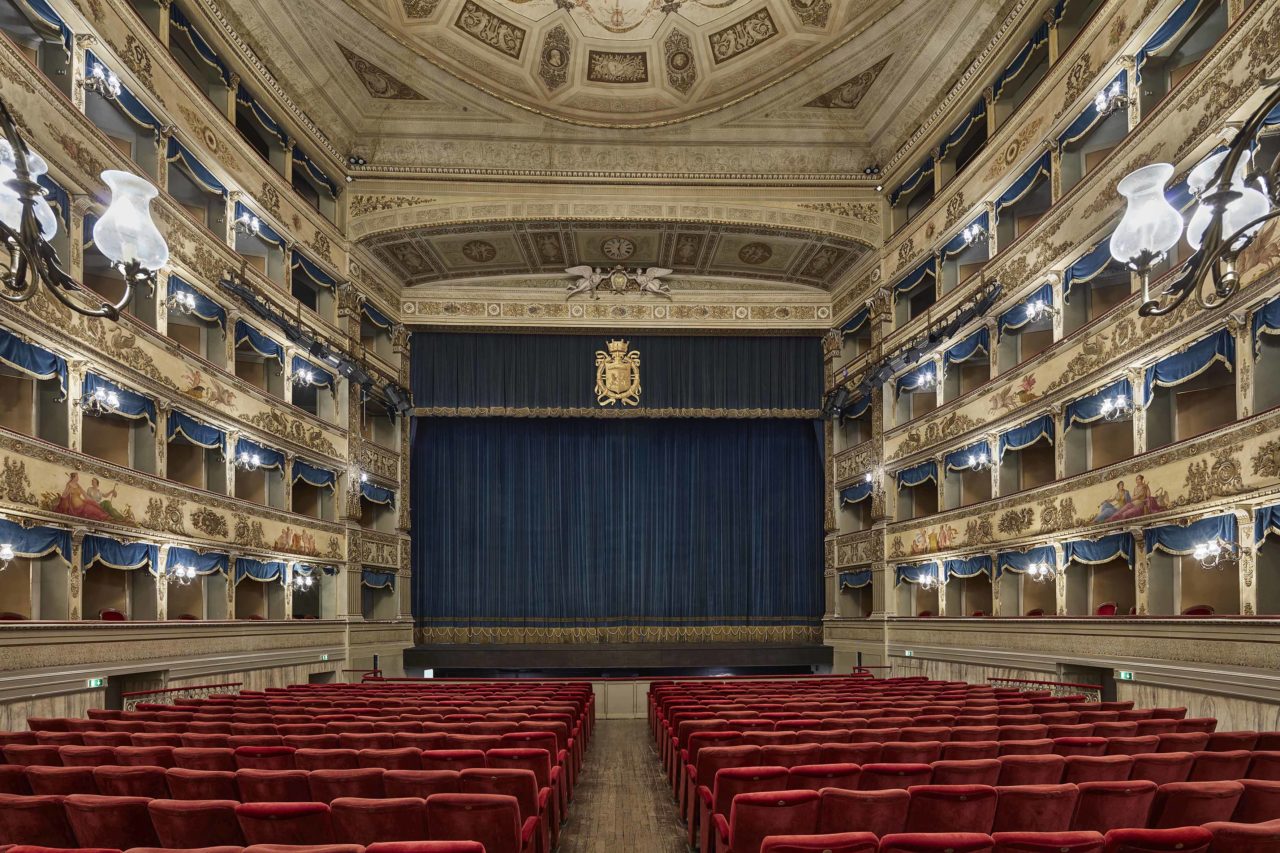
ALIGHIERI THEATRE RAVENNA
Early decades of the 19th century: after over a hundred years, the Communicative Theatre, entirely made of wood, is deteriorating, and the Civic Administration decides to build a new structure. Meanwhile, a suitable location must be found, and the choice falls on Piazzetta degli Svizzeri, shabby and surrounded by shanties, but right in the city center. In 1838, the project is entrusted to two Venetian architects, the Meduna brothers, Tomaso and Giovan Batista. The former oversaw the restoration of the Teatro La Fenice in Venice, which was partially destroyed by a fire. He also designed the first railway bridge connecting Venice to the mainland. Thus, a neoclassical building is born, similar in many respects to the Venetian theatre. It is the apostolic delegate, Monsignor Stefano Rossi, who suggests dedicating it to Dante Alighieri.


