


AVAILABLE UNTIL
IL TABARNO
Music by Giacomo Puccini
Opera in one act
Libretto by Giuseppe Adami
Michele, barge owner, 50 years old Franco Vassallo
Luigi, stevedore, 20 years old Roberto Aronica
Tinca, stevedore, 35 years old Xin Zhang*
Talpa, stevedore, 55 years old Luciano Leoni
Giorgetta, Michele’s wife, 25 years old Chiara Isotton
Frugola, Talpa’s wife, 50 years old Cristina Melis
A Song Vendor Marco Puggioni
A Lover Cristobal Campos
A Mistress Tatiana Previati
Conductor Roberto Abbado
Director Pier Francesco Maestrini
Chorus Master Gea Garatti Ansini
Sets Nicolás Boni
Costumes Stefania Scaraggi
Lighting Daniele Naldi
Assistant Director Michele Cosentino
The new world premiere production of Giacomo Puccini’s Triptych, in the vision of director Pier Francesco Maestrini and the interpretation of conductor Roberto Abbado, metaphorically refers to Dante Alighieri’s Divine Comedy.
The director’s idea of juxtaposing Puccini’s three one-act operas with the three canticles of the Divine Comedy – Inferno, Purgatorio, Paradiso – stems from one of the composer’s earliest projects for his Triptych, later abandoned, maintaining a direct Dantean reference only in Gianni Schicchi. However, according to Maestrini, “this idea remains with the damned souls in Il Tabarro, with the souls awaiting redemption in Suor Angelica, with the stroke of genius of the ‘paradisiacal’ Schicchi. It is no coincidence,” explains the director, “if a good part of the third title composing the trilogy is written in hendecasyllables, or when Suor Angelica appears and sings ‘Desires are the flowers of the living, they do not bloom in the realm of the dead…’ it refers to the prayer of Saint Benedict in Paradise.”
Among the visual references in the production – with sets by Nicolás Boni, costumes by Stefania Scaraggi, and lighting by Daniele Naldi – stands out the one to Gustave Doré’s illustrations for the Divine Comedy “which, moreover,” continues Maestrini, “have influenced so much cinema, including that Beyond Dreams which I would say is my main reference for this Triptych.”
EXTRA
LIVE FROM.
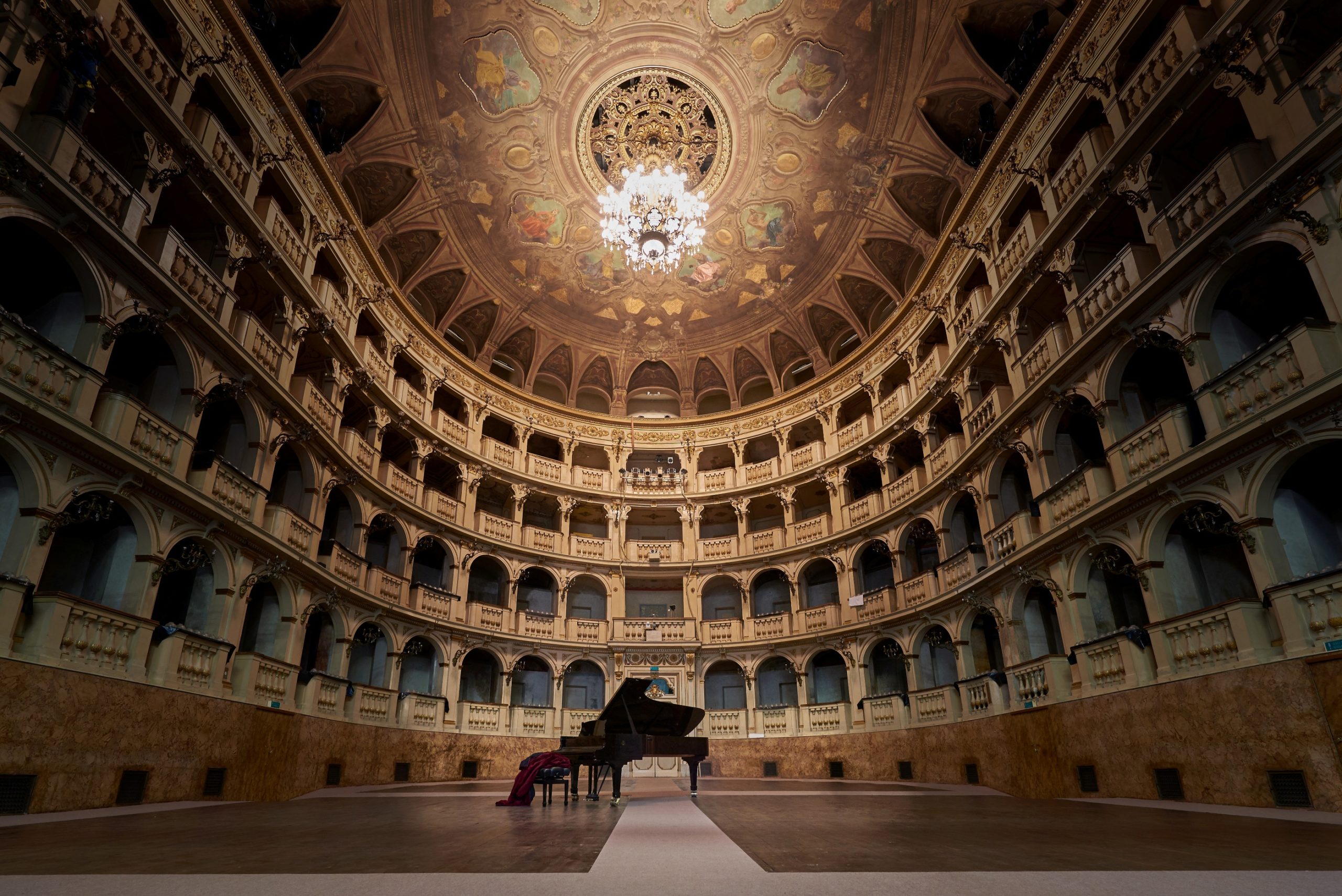
TEATRO COMUNALE DI BOLOGNA
Built to host Italian melodrama, the Teatro Comunale carries with it not only its own history but also the entire history of the city that hosts it, in the place where the splendid Palazzo dei Bentivoglio was once admired. From the beginning, the Comunale established itself as the major theater of a city that, from the late 17th century until the triumph of Casa Ricordi and industrial publishing, played the role of the capital of the Italian opera production system. The theater has dominated, from its inception, the fabric of a city that was home to an impressive number of agents, impresarios, singers, dancers, instrumentalists, designers, and scene and costume renters, as well as the influential Accademia Filarmonica, which, among others, graduated a fourteen-year-old Wolfgang Amadeus Mozart under the guidance of Padre Martini.


