


VIDEO NO LONGER AVAILABLE
Carmen
Music by Georges Bizet
Opéra-comique in four acts
Libretto by Henry Méilhac and Ludovic Halévy
from the novel Carmen by Prosper Mérimée
Carmen Martina Belli
Don José Arturo Chacon Cruz
Escamillo Marco Caria
Micaela Laura Giordano
Dancairo, Alessio Verna
Remendado Saverio Fiore
Morales Gianni Giuga
Zuniga Massimiliano Catellani
Frasquita Anna Maria Sarra
Mercedes Chiara Tirotta
Conductor Jordi Bernacer
Director Silvia Paoli
Sets Andrea Belli
Costumes Valeria Donata Bettella
Lighting Marcello Lumaca
Video Francesco Corsi
Choreography Carlo Massari/C&C Company
ORCHESTRA DELL’EMILIA-ROMAGNA “ARTURO TOSCANINI”
BANDA DELL’ORCHESTRA GIOVANILE DELLA VIA EMILIA
CHORUS OF THE TEATRO REGIO DI PARMA
Choir Master Martino Faggiani
CHILDREN’S CHOIR OF THE TEATRO REGIO DI PARMA
Children’s choir master Massimo Fiocchi Malaspina
in co-production with Fondazione Teatro Regio di Parma and Fondazione I Teatri di Reggio Emilia
“In this staging, there is, particularly for me, the revelation of how this is yet another story of a woman seen through the eyes of men,” explains director Silvia Paoli, who has directed works such as Cinderella in Tenerife, The Marriage of Figaro and Capuleti e Montecchi later reprised at the Comunale di Bologna, Turandot for AsLiCo, Vent du Soir and The Barber of Seville in Florence, The Moth Princess in Oman, Otello for Progetto 200.com in Como, Enrico di Borgogna in Bergamo.
“The entire story is actually subjective, it is the confession of a condemned man, and what is narrated unfolds through two deaths, that of Carmen and the decreed death of Don José – continues Silvia Paoli – It seemed important to me to focus on the fact that Carmen does not really exist except through the words of her killer and that therefore the true protagonist of the story is Don José, the one who carries the action forward. We know nothing of Carmen that is not in relation to him, Carmen does not change, Don José transforms in the name of a passion (which I am careful not to call love) experienced in an obsessive, unhealthy manner, which leads him to not tolerate the idea of no longer being able to possess what he wants; a story that we could very well read today in the news of any newspaper. I therefore thought of a prison and the entire story not so much as a flashback but rather as an obsessive memory of Don José who relives from his cell the encounter with Carmen and the tragic epilogue of his story, recounting it to himself and distorting it through imagination, his own point of view. The memory emerges from the box of personal items and thus the flower, the photo of Micaela, a newspaper clipping, sand in a shoe, which evoke spaces and situations. The image of Carmen and their story is so haunting that Don José comes to confuse reality with memory, so much so that he even distorts the everyday, in a spiral that will lead him to identify with what he remembers, to live continuously between dream and wakefulness without almost being able to distinguish them anymore. Since the 1960s was a period in which a process of emancipation began to be realized for women (I recall that in Italy the crime of adultery was abolished in 1968 and the crime of honor only in 1981) and the pillars of patriarchy were questioned, it seemed right to place the story in those years, where the dream of many men continues to oscillate between the devoted wife and the lascivious lover (the Saint and the demon, Micaela and Carmen) but for “the weaker sex” prospects of growth and rebellion open up. Throughout the opera, women are considered as merchandise, they must be paid, they exist as cigar makers (easy and light women) or to distract customs officers with smiles and body parts; it is a male eye that looks, reality is filtered, it is a man who speaks. I am convinced that to talk about femicide without rhetoric it is more necessary than ever for Carmen to die; calling the one who killed her not “betrayed lover” or “jealous boyfriend” but murderer and putting him in prison is a way to do justice to Carmen and to all women who want to be themselves, regardless of the desires of others”.
EXTRA
LIVE FROM.
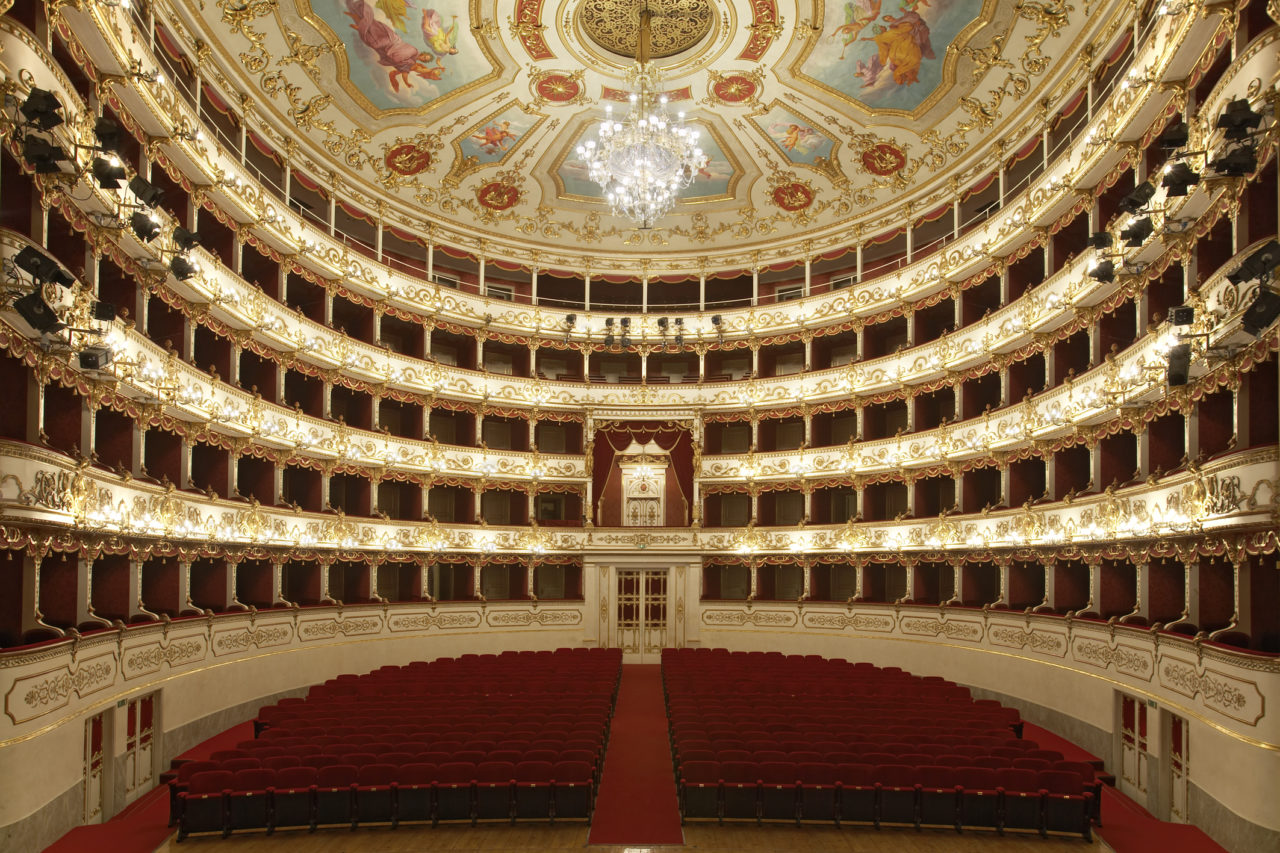
VALLI THEATRE REGGIO EMILIA
The majestic Teatro Municipale Valli, surrounded by public gardens, covers an area of 3,890 square metres. Every year, it hosts a prestigious opera and concert season, as well as a rich programme of dance, musicals and musical theatre performances. It has a media library and a historical discotheque open to the public. The complex was built between 1852 and 1857, according to the design of Modena architect Cesare Costa, and today appears virtually unchanged from the time of its inauguration. In 1980, it was dedicated to the Reggio Emilia actor Romolo Valli.


