

VIDEO NO LONGER AVAILABLE
The Uninhabited Island
Music by Franz Joseph Haydn
Theatrical action in two parts
Libretto by Pietro Metastasio
Publisher Bärenreiter-Verlag, Kassel
Representative for Italy Casa Musicale Sonzogno di Piero Ostali, Milan
Costanza Giuseppina Bridelli
Silvia Anna Maria Sarra
Gernando Kristian Adam
Enrico Christian Senn
Conductor Nicola Valentini
Director, sets, lighting, and video Luigi De Angelis
Dramaturgy and costumes Chiara Lagani
Assistant director and video Andrea Argentieri
Production manager Giuliana Rienzi
DOLCE CONCERTO ENSEMBLE
Fortepiano Jacopo Raffaele
NEW PRODUCTION
Teatro Alighieri di Ravenna
in co-production with Opéra de Dijon
in collaboration with Fanny & Alexander
An island like a room, its perimeter the boundary of the world, at its vertices four characters who lose and find themselves: the 2021/22 Opera Season of Teatro Alighieri opens with a… happy shipwreck, that on The Uninhabited Island by Haydn. The premiere of this project curated by Fanny & Alexander, an international co-production featuring Opéra de Dijon alongside Alighieri, coincides with the debut of Luigi De Angelis and Nicola Valentini as director and conductor of an opera in their city. With the awareness of how Metastasio’s libretto, which Haydn set to music for the Esterházy court, lends itself to reflections on solitude and isolation, the new production explores the thin boundary between real and virtual, while images of the Sicilian island of Marettimo, in the Egadi, flow on stage. Valentini conducts the Dolce Concento Ensemble with Jacopo Raffaele on the fortepiano and the four voices are those of sopranos Giuseppina Bridelli and Anna Maria Sarra, tenor Krystian Adam, and bass Christian Senn; alongside De Angelis – who handles sets, lighting, and video in addition to directing – Chiara Lagani for dramaturgy and costumes and Andrea Argentieri, as assistant director and video.
No man is an island, preached the poet John Donne in the famous Meditation XVII, a good century and a half before Haydn, in 1779, set out to compose on the theme of the confrontation between the state of nature and civilization, between the primal innocence of the noble savage and the corruption of human society, undoubtedly one of the querelles most cherished by Enlightenment salons. A debate that this new production rereads in explicitly contemporary terms: “For the Romans, the insula was the house – notes Luigi De Angelis – In neurology, the insula is the part of the brain most connected with empathy and painful emotions. In Haydn’s work, the island is a metaphor for a state of mind that perhaps, in this historical moment, concerns us closely. I believe we will all carry the sensation of confinement, isolation, and dealing with a limited vital perimeter for a long time. Every broader exploration has been entrusted to imagination, creativity, the permeable and pulsating walls of the dream.”
With Chiara Lagani, De Angelis imagined that the protagonist Costanza, or rather the singer who plays her, slips into a deep sleep: “Her mind is the island itself – he explains – we spectators are witnesses to her most secret inner projections. The other singer, her sister Silvia, represents the gaze that can contemplate a distant, unknown horizon, from which to be seduced, that is, to be abducted, led into a new, foreign territory. Silvia represents the more animalistic and natural, childlike, still genuine and fluid double, not stiffened, not affected by the experience of the pain of abandonment. And it will be through Silvia’s perspective and the dream that Costanza will be able to dissolve her stone armor and overturn her gaze on humankind, rediscovering lost harmony and trust in others.”
In this delightful Enlightenment fable, Costanza (Giuseppina Bridelli) and her younger sister Silvia (Anna Maria Sarra) have been abandoned to their fate on a deserted island, and here Gernando (Krystian Adam), Costanza’s husband, and his friend Enrico (Christian Senn) land. Costanza, convinced she has been deserted by Gernando, has taught Silvia to fear men, but this does not prevent the young woman from experiencing the first amorous turmoil caused by meeting Enrico. Despite misunderstandings, Costanza finally learns that Gernando was separated from her only because he was kidnapped by pirates, and Enrico declares himself to Silvia. Through the influence of Gluck’s Orpheus and Eurydice, this two-part opera represents a unique piece in Haydn’s musical theater, marked as it is by the disappearance of dry recitatives in favor of a constant flow of music that gives it a particularly modern nature. The pages also include a splendid dramatic overture in the style of the Sturm und Drang symphonies, while it concludes with an imposing quartet in which the protagonists are accompanied by four concertante instruments – violin, cello, flute, and bassoon – that anticipates Mozart’s The Abduction from the Seraglio.
EXTRA
LIVE FROM.
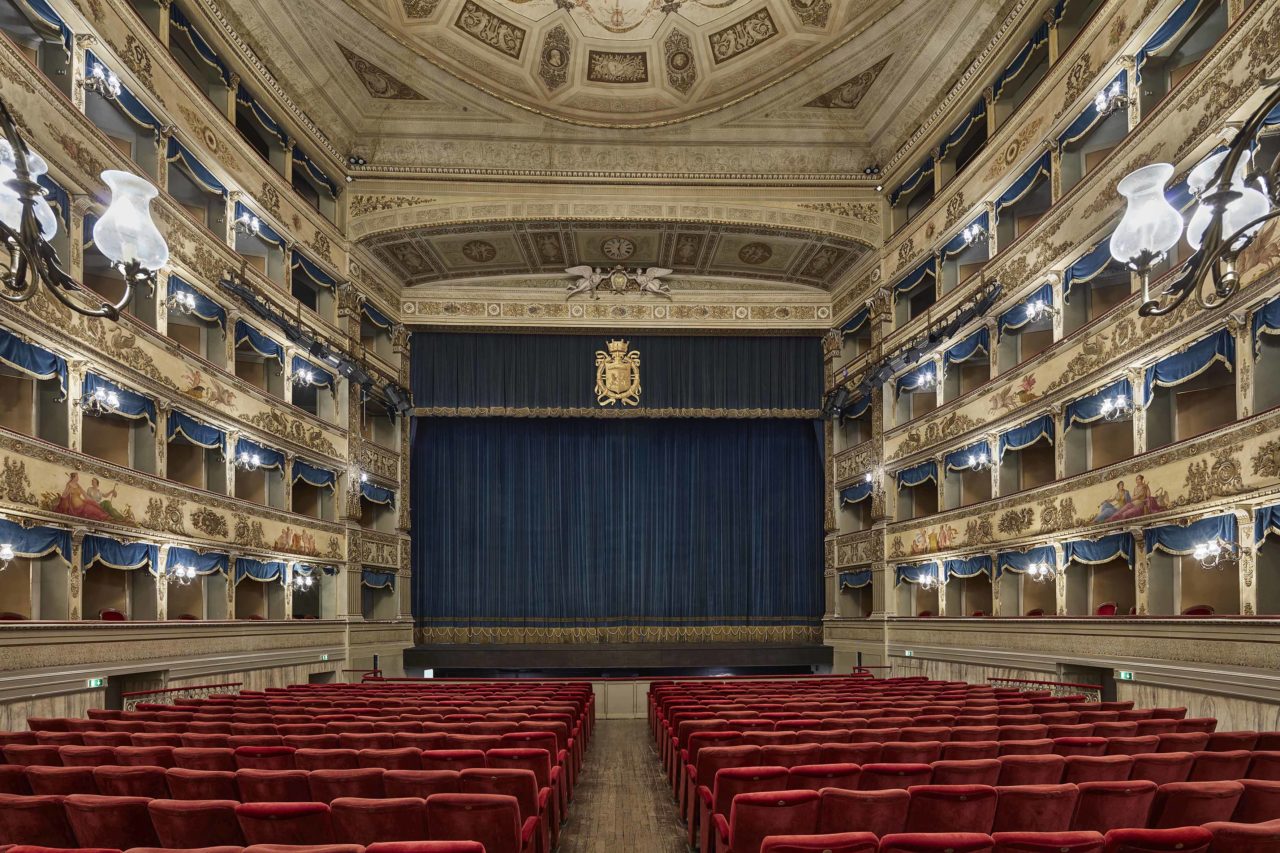
ALIGHIERI THEATRE RAVENNA
Early decades of the 19th century: after over a hundred years, the Communicative Theatre, entirely made of wood, is deteriorating, and the Civic Administration decides to build a new structure. Meanwhile, a suitable location must be found, and the choice falls on Piazzetta degli Svizzeri, shabby and surrounded by shanties, but right in the city center. In 1838, the project is entrusted to two Venetian architects, the Meduna brothers, Tomaso and Giovan Batista. The former oversaw the restoration of the Teatro La Fenice in Venice, which was partially destroyed by a fire. He also designed the first railway bridge connecting Venice to the mainland. Thus, a neoclassical building is born, similar in many respects to the Venetian theatre. It is the apostolic delegate, Monsignor Stefano Rossi, who suggests dedicating it to Dante Alighieri.


