

VIDEO NO LONGER AVAILABLE
The Barber of Seville
Music by Gioachino Rossini
Comedy for music in two acts
Libretto by Cesare Sterbini
Count Almaviva Cesar Cortès
Bartolo Pablo Ruiz
Rosina Michela Antenucci
Figaro Simone Del Savio
Basilio Guido Loconsolo
Berta Ana Victoria Pitts
Fiorello / An officer Alex Martini
Conductor Leonardo Sini
Director Fabio Cherstich
Sets Nicolas Bovey
Costumes Arthur Arbesser
Lighting Marco Giusti
PHILHARMONIC OF THE ITALIAN OPERA BRUNO BARTOLETTI
CLAUDIO MERULO CHOIR OF REGGIO EMILIA
Choir Master Martino Faggiani
NEW PRODUCTION
Co-production by Fondazione I Teatri di Reggio Emilia and Fondazione Teatro Comunale di Modena
Fabio Cherstich, director
I imagined the show as a large clockwork mechanism, an empty space that fills scene by scene with images and elements that have nothing to do with traditional Spain: the only concession being a bullfighter and wild Figaro. The singers and choir in modern or otherwise reinvented and stylized outfits by the Austrian designer Arthur Arbesser. Erwin Wurm, Maurizio Cattelan, and Carsten Holler are the visual references shared with the set designer Nicholas Bovey and the lighting designer Marco Giusti.
We dress Almaviva in 18th-century style. He, the prince, will be the only one in old-fashioned attire, destined to disguise himself (as per the plot!), in an 18th-century costume and a strict priest. And then, as if to embody the irresistible “madness” of the music, as well as the pure enjoyment that can be derived from detaching it from any realism, proportions are reversed in the scene where everything runs on tracks or suddenly rises and falls.
In the workshop of the wicked Doctor Bartolo, a more and more annoyed Rosina is forced into the role of a student, Berta is caught drinking inside a refrigerator or stationed in the gridiron to drop theater weights and ropes on the suitors. Basilio emerges from the underground and when he arrives on stage it seems like everything falls apart. Figaro’s shop sign becomes a gigantic and luminous inscription, in Broadway style, to accompany the most famous barber in theater history, a true superstar. The count disguised as a priest makes his entrance accompanied by a heavy confessional. Showers of coins and money, trapdoors, the entrance of the force on a toy tank. And still more disguises and subterfuges. Ambrogio is a clumsy and reckless waiter played by the French mime Julien Lambert.
A young conductor, Leonardo Sini, coordinating a show that I hope will be pyrotechnic, despite the limited times we are experiencing both outside and inside the scene. A detached and disorienting amusement, a visual madness that aims to be the direct and overwhelming emanation of Rossini’s music.
Arthur Arbesser, costume designer
EXTRA
LIVE FROM.
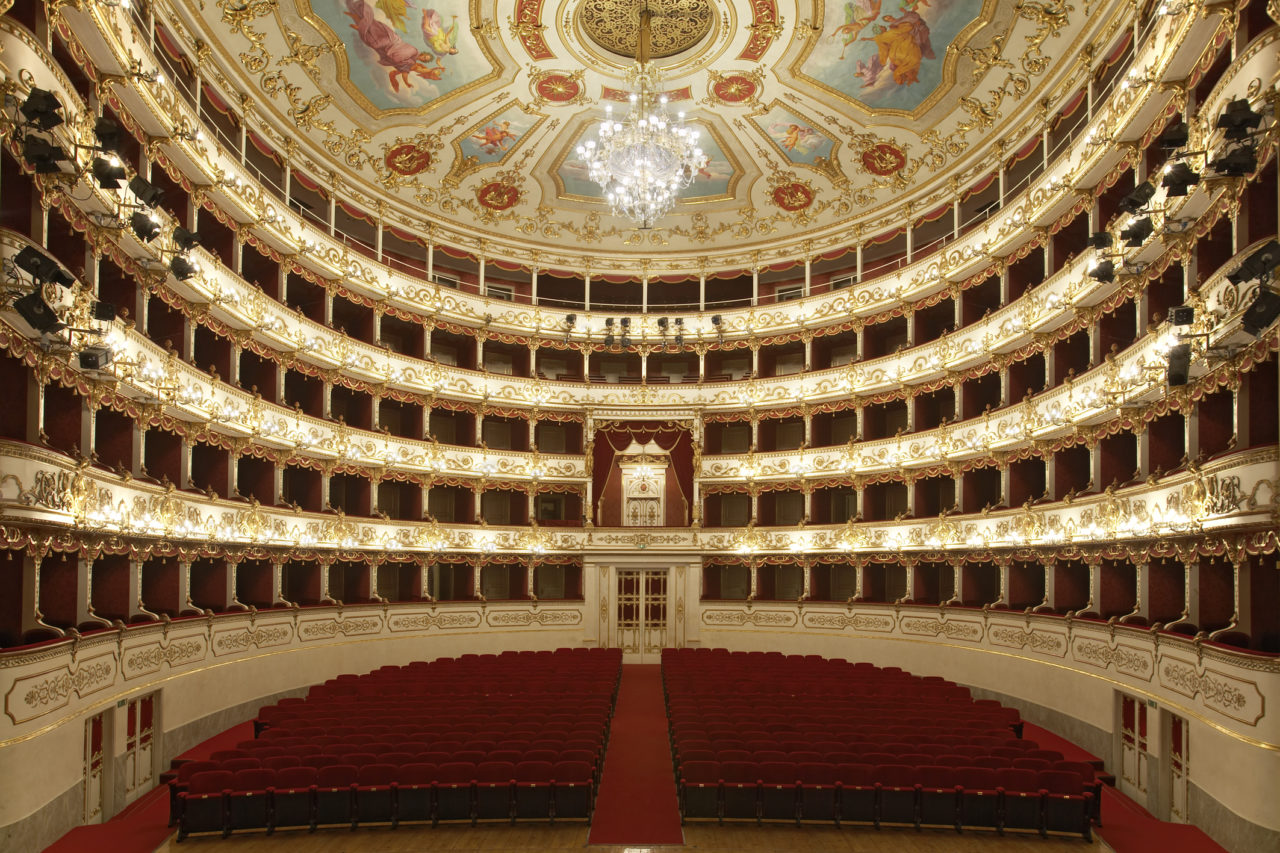
VALLI THEATRE REGGIO EMILIA
The majestic Teatro Municipale Valli, surrounded by public gardens, covers an area of 3,890 square metres. Every year, it hosts a prestigious opera and concert season, as well as a rich programme of dance, musicals and musical theatre performances. It has a media library and a historical discotheque open to the public. The complex was built between 1852 and 1857, according to the design of Modena architect Cesare Costa, and today appears virtually unchanged from the time of its inauguration. In 1980, it was dedicated to the Reggio Emilia actor Romolo Valli.


