


AVAILABLE UNTIL JULY 21, 2024
THE CORONATION OF POPPEA
Music by Claudio Monteverdi
Drama for music in a prologue and three acts
Libretto by Giovanni Francesco Busenello
First performance Teatro Santi Giovanni e Paolo in Venice, 1643
Poppea Roberta Mameli
Nerone Federico Fiorio
Ottavia Josè Maria Lo Monaco
Ottone Enrico Torre
Seneca Federico Domenico Eraldo Sacchi
Arnalta Candida Guida
Drusilla Chiara Nicastro
Lucano/1st Soldier/2nd Attendant Luigi Morassi
Liberto/2nd Soldier/Consul Luca Cervoni
Mercury/3rd Attendant/Tribune/Lictor Mauro Borgioni
Nurse/1st Attendant Danilo Pastore
Venus/Fortune Francesca Boncompagni
Love/Page Paola Valentina Molinari
Virtue/Maid/Pallas Giorgia Sorichetti
Conductor and Director Antonio Greco
Director, Sets, Costumes and Lighting Pier Luigi Pizzi
Assistant Director and Set Lorenzo Mazzoletti
Costume Assistant Lorena Marin
Assistant Light Designer Oscar Frosio
MONTEVERDI FESTIVAL ORCHESTRA – CREMONA ANTIQUA
Production Fondazione Teatro Amilcare Ponchielli di Cremona
in co-production with OperaLombardia, Teatro Verdi di Pisa, Teatro Alighieri di Ravenna
“I designed a metaphysical scene rooted in the classical stage of Sebastiano Serlio from the Renaissance theater, an emblematic square where two worlds face each other,” explains director Pier Luigi Pizzi, describing what «Il Sole 24 Ore» called the best opera production of 2023. A production that arrives in Ravenna after its summer debut at the Monteverdi Festival in the Teatro Ponchielli in Cremona, the leader of the co-production that includes Alighieri alongside OperaLombardia and Teatro Verdi di Pisa. “At the center is a tree – continues Pizzi – a tree with golden branches facing Poppea’s residence because they have received a beneficial fortunate wind, on the other side the dry branches that speak to us of Ottavia’s solitude. Then there is a golden globe, which is the place where Love exercises its power. (…) Busenello’s is one of the most beautiful opera librettos there is: it speaks to us directly, with such a level of language that it reaches anyone and gives us the opportunity to easily recognize ourselves in the characters of this opera.”
First performed in Venice in 1643 and the first opera with a historical subject (librettist Giovanni Francesco Busenello was inspired by Tacitus’ Annals), The Coronation of Poppea has come down to us in two manuscripts whose differences reveal manipulations and rewritings – presumably, the elderly master availed himself of his students’ contributions to stage his last great masterpiece. “The genesis of this opera is thus a Homeric question, where there are many doubts and few certainties – emphasizes Antonio Greco, conductor and director – We chose to stage the most agile Venetian manuscript found in 1888, but inserted the ‘Neapolitan’ instrumental ritornellos from the manuscript rediscovered in 1929. Dramaturgically, nothing changes: the moments when the instrumental ritornellos appear are almost entirely superimposable and the continuo lines are almost always identical. But, while the Venetian instrumental is in three parts, the Neapolitan is in four parts. To these, I allowed myself to add a fifth part, to adapt the score to our orchestra and our theater.”
EXTRA
LIVE FROM.
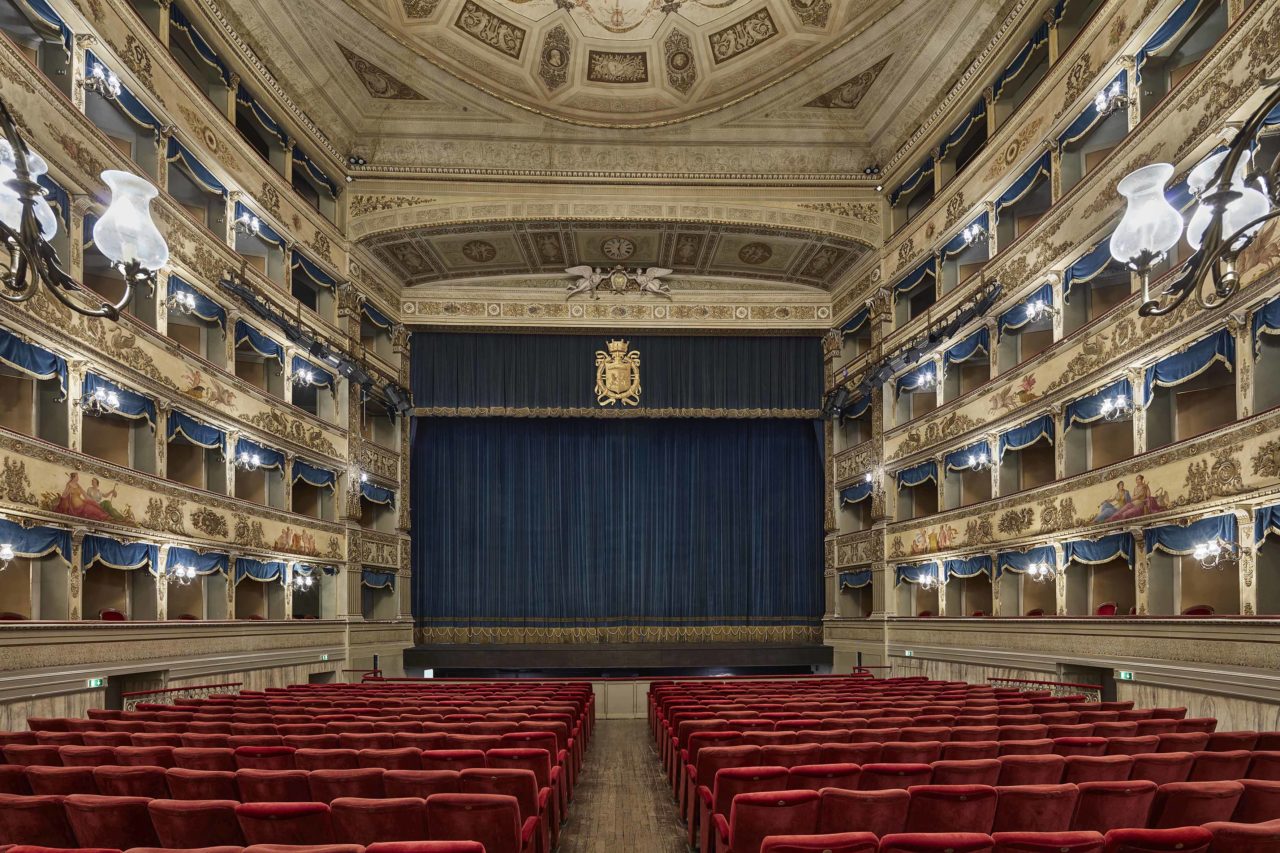
ALIGHIERI THEATRE RAVENNA
Early decades of the 19th century: after over a hundred years, the Communicative Theatre, entirely made of wood, is deteriorating, and the Civic Administration decides to build a new structure. Meanwhile, a suitable location must be found, and the choice falls on Piazzetta degli Svizzeri, shabby and surrounded by shanties, but right in the city center. In 1838, the project is entrusted to two Venetian architects, the Meduna brothers, Tomaso and Giovan Batista. The former oversaw the restoration of the Teatro La Fenice in Venice, which was partially destroyed by a fire. He also designed the first railway bridge connecting Venice to the mainland. Thus, a neoclassical building is born, similar in many respects to the Venetian theatre. It is the apostolic delegate, Monsignor Stefano Rossi, who suggests dedicating it to Dante Alighieri.


