

VIDEO NO LONGER AVAILABLE
Aci, Galatea and Polifemo
Music by Georg Friedrich Händel
Ecology of an Eternal Love
Libretto by Niccolò Giuvo
Reconstruction and critical edition: Fabrizio Longo, Raffaele Pe, Luca Guglielmi
First staging in modern times of the version “Per Senesino” (ms. Egerton 2953)
Aci Raffaele Pe
Galatea Giuseppina Bridelli
Polifemo Andrea Mastroni
Concertmaster and harpsichordist Luca Guglielmi
Director, sets and costumes Gianmaria Aliverta
Video projections TOKIO STUDIO
Lights Elisabetta Campanelli
Ensemble Barocco LA LIRA DI ORFEO
Produzione
Fondazione Teatri di Piacenza
Aci, Galatea and Polifemo, a serenata for three voices composed in 1708 by a very young Händel in Naples, underwent versions and adaptations for over thirty years, until 1739. This new production by the Teatro Municipale di Piacenza represents the first modern performance of the version written for the famous castrato singer Francesco Bernardi known as Senesino, in the reconstruction and critical edition by Fabrizio Longo, Raffaele Pe, and Luca Guglielmi.
Starring the countertenor among the most appreciated of the new generation Raffaele Pe (in the role of Aci), the mezzo-soprano Giuseppina Bridelli (Galatea), a voice particularly sought after in the Baroque repertoire, and Andrea Mastroni (Polifemo), an internationally renowned bass. Conductor and harpsichordist is Luca Guglielmi, an artist highly appreciated for his historically informed performances, leading the Baroque ensemble La Lira di Orfeo. Direction, set, and costumes are by Gianmaria Aliverta, one of the most interesting young opera directors; video projections by Tokio Studio.
The myth of Aci and Galatea, narrated in Ovid’s Metamorphoses, is transposed into the 1708 libretto by the Neapolitan Nicolò Giuvo. The legend takes place in Sicily: the love between the sea nymph Galatea and the shepherd Aci arouses the jealousy and wrath of the Cyclops Polifemo, who kills his rival by hurling a piece of mountain at him. Galatea obtains from her father Nereus that Aci’s blood be transformed into a river, so that he can reunite with the sea and thus make their love eternal. The sea stacks of the bay of Aci Trezza and the nine villages bearing the name of Aci will guard the relics of the young shepherd’s dismembered body.
EXTRA
LIVE FROM.
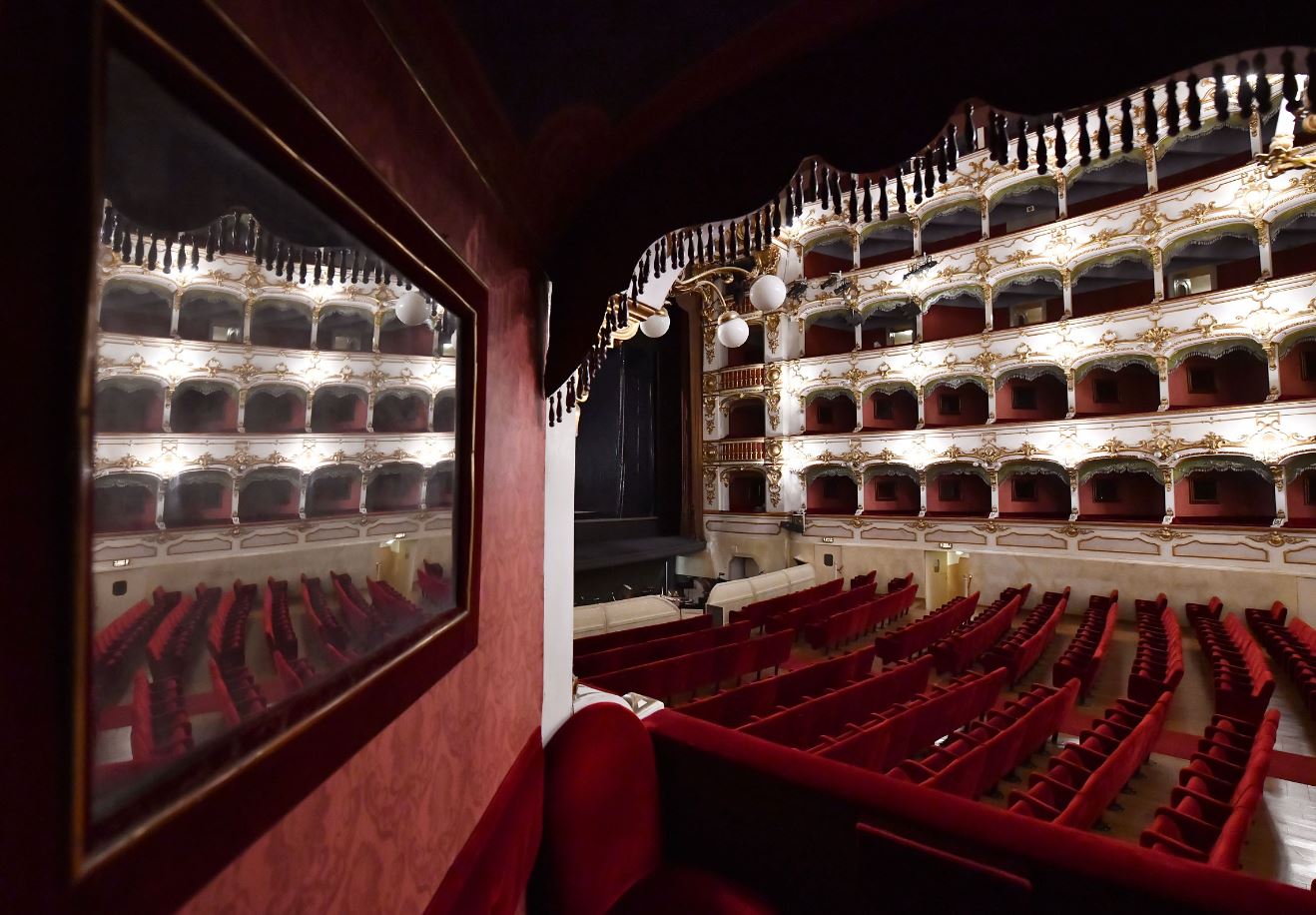
MUNICIPAL THEATRE OF PIACENZA
A splendid example of late 18th-century architecture, Piacenza’s Municipal Theater was inaugurated on September 10, 1804, with Zamori, or Hero of the Indies, a dramma serio for music by Giovanni Simone Mayr, a Bavarian musician who was Gaetano Donizetti’s teacher and who lived for a long time in Bergamo.
Construction of the theater, designed by Piacenza architect Lotario Tomba (author, among other things, of the Governor’s Palace in Piazza Cavalli) began in September 1803 and was completed the following year.
Piacenza was the first city in Emilia to have a new, modernly conceived, capacious and, above all, beautiful theater; Parma would have it in 1829, Modena in 1838, Reggio Emilia in 1857.


